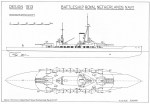
This is a Dutch dreadnought design from 1913, modeled in 1/6000 scale. Various designs were proposed from 1912 through 1914, as described in Warship International No. 4, 1988, No. 1, 1989 and No. 4, 1989. The 1913 quadruple turret design was chosen because it differed the most from contemporary German designs.
This alternate history scenario was a confrontation between British and French ships in November 1914. The British were tasked with preventing the return of the French fleet from Oran to Toulon. The French were to get underway from the anchorage at Oran and get past the British.
This Friday we played a fictitious naval battle set in the North Sea in 1916. The British attempt to sweep the Heligoland Bight to eliminate German patrols. The Germans are supporting their light forces with heavy ships. The scenario includes ships not actually available in the North Sea at the time.
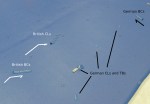
Initially only the 3rd British BCS and its CL screen enter the Bight.
When German BCs are engaged, the remaining British forces move in from the north.
Heligoland in 1/18000 scale (the game’s ground scale)
We played for about 4 hours without a decisive result. The British had suffered somewhat more damage. In spite of a lot of torpedo fire from the light cruisers and destroyers, the only two torpedo hits were achieved by the Von der Tann and the Blucher.
This weekend the local HMGS-South group played a Second World War naval game using the Seekrieg 5 rules. The scenario was fictional, but included ships present near Leyte Gulf on 25 October 1944.
US:
Battleships West Virginia, Mississippi, Tennessee, Pennsylvania
Cruisers Louisville, Portland, Minneapolis, Indianapolis
Transport ships of the Leyte invasion fleet were present nearby and provided a potential target for the Japanese.
The models are 1/2400 scale GHQ and CinC. Seven players participated.
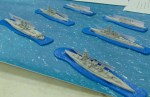
The US ships start at 5 knots, with the cruiser line on the engaged side.
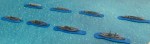
The Japanese are in three columns, and will take some effort to deploy.
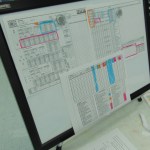
Color-coded play aids help explain the ship data.
The US cruisers turn to close the reported enemy, but the battleships are not allowed to react immediately.
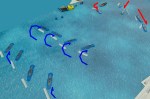
Careful maneuvering avoids collisions as the Japanese deploy.
The Tone has blown up.
US cruisers reverse course to avoid land, but damage limits the turning ability of Minneapolis.
We played seven turns in about 4 hours. Of the US battleships, only Pennsylvania was hit and took one tier of damage. Portland took two tiers of damage. Minneapolis took one tier and lost a primary turret. The two Japanese battleships took little or no damage. Kongo took two tiers of damage and lost a primary turret. Haruna three tiers, an engine room, a boiler room, a primary gun and all primary fire control. Chikuma had significant damage and fires. Tone blew up.
This weekend the local HMGS-South group played a game of Ironclads, using the board game rules with some adjustments to accommodate miniatures larger that the game’s one-hex ship counters.
The scenario was to be loosely based on the CSS Arkansas attacking the Union fleet at Baton Rouge in August of 1862. The large number of players that showed up required some non-historical ship additions .
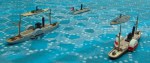
The ships were 1/600 scale models from Thoroughbred.
Confederate fleet.
Union fleet.
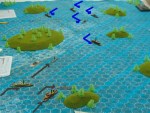
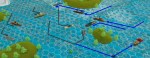
Initial setup with a lone Union picket watching the channel.
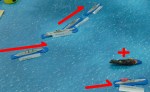
Signaling errors result in an early collision in the Confederate fleet.
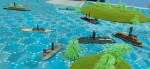
The Union picket ship, under fire from the Confederate fleet, maneuvers out of the way.
Collisions are narrowly avoided in mid channel. The Union picket is on fire and will eventually be abandoned.
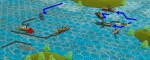
The Manassas has maneuvered for a ram attack but suffers a rudder hit just short of the enemy.
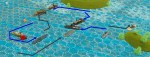
The Arkansas runs through the Union fleet. A Confederate sidewheeler’s boilers explode as she burns.















 ncc1717.com
You must be logged in to post a comment.