Seekrieg 5 – Alternate Battle of Samar

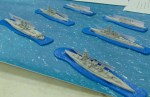
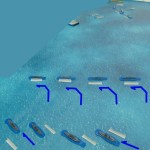
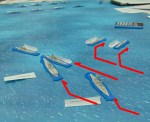
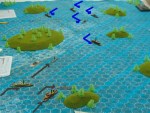
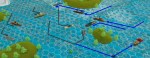
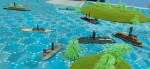
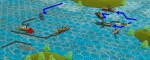
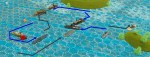
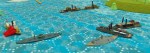
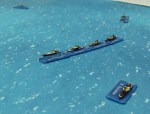
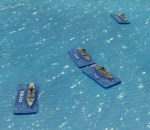
This weekend the local HMGS-South group played a Second World War naval game using the Seekrieg 5 rules. The scenario was fictional, but included ships present near Leyte Gulf on 25 October 1944.

US:
Battleships West Virginia, Mississippi, Tennessee, Pennsylvania
Cruisers Louisville, Portland, Minneapolis, Indianapolis

Japanese:
Battleships Yamato, Nagato
Battlecruisers Kongo, Haruna
Cruisers Tone, Chikuma

Transport ships of the Leyte invasion fleet were present nearby and provided a potential target for the Japanese.

The models are 1/2400 scale GHQ and CinC. Seven players participated.
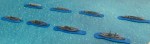
We played seven turns in about 4 hours. Of the US battleships, only Pennsylvania was hit and took one tier of damage. Portland took two tiers of damage. Minneapolis took one tier and lost a primary turret. The two Japanese battleships took little or no damage. Kongo took two tiers of damage and lost a primary turret. Haruna three tiers, an engine room, a boiler room, a primary gun and all primary fire control. Chikuma had significant damage and fires. Tone blew up.
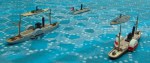
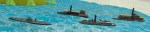
ACW Ironclads

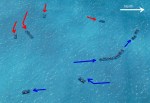
This weekend the local HMGS-South group played a game of Ironclads, using the board game rules with some adjustments to accommodate miniatures larger that the game’s one-hex ship counters.

The scenario was to be loosely based on the CSS Arkansas attacking the Union fleet at Baton Rouge in August of 1862. The large number of players that showed up required some non-historical ship additions .
The ships were 1/600 scale models from Thoroughbred.


Seekrieg 5 – Tsushima

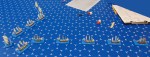
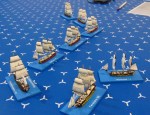
This weekend the local HMGS-South group played a Russo-Japanese War naval game using the Seekrieg 5 rules. The scenario included battleships from the Battle of Tsushima.

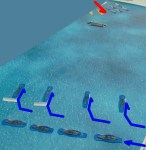
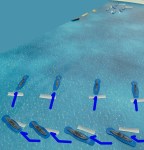
The battle was fought in calm seas and hazy weather, visibility 12,000 yards. The lead ships started about 12,000 yards apart.

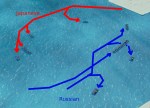
Japanese ships in a single line ahead:
Mikasa, Asahi, Fuji, Shikishima, Chin Yen

Russian ships in two divisions, each in line ahead:
Kniaz Suvarov, Imperator Alexander III, Borodino, Orel
Oslyabya, Sissoi Veliki, Navarin, Imperator Nicolai I

Crew quality was randomized, with the Japanese having a probable advantage:

Japanese:
1-20%       +1
21-80%    +2
81-100%  +3

Russian:
1-30%        -1
31-90%       0
91-100%   +1

The battle opened with the Borodino class ships firing at the four new Japanese battleships, the Oslyabya firing at the Chin Yen and the four Japanese battleships firing on the lead pair of each Russian division. The guns of the remaining ships would be out of range for several turns. The Japanese soon switched to firing their primary guns on the four Borodino class and their secondary guns on the older Russian ships. The Imperator Alexander III lost an engine room on the first turn, forcing her to leave the formation. That was the story for the rest of the battle, with the Russian first division taking most of the damage.

After 14 turns and more than four hours of real time, the damage was:

Russian:
Kniaz Suvarov                      3 tiers, speed reduced to 7 knots
Imperator Alexander III    1 tier, speed reduced to 9 knots
Borodino                               light damage
Orel                                        8 tiers, speed reduced to 11 knots,
–                                               no main battery, sinking
Oslyabya                               light damage
Sissoi Veliki                          light damage
Navarin                                  light damage
Imperator Nicolai I             light damage

Japanese:
Mikasa                                    light damage
Asahi                                       light damage
Fuji                                           light damage
Shikishima                             1 tier, speed reduced to 8 knots
Chin Yen                                 1 tier