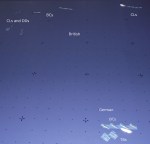
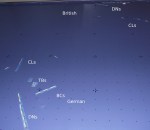
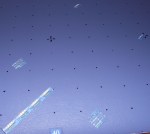
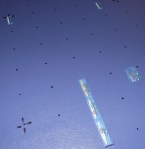
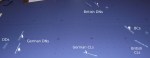
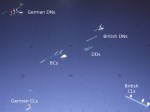
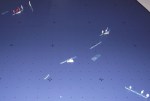
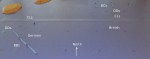
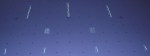
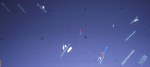
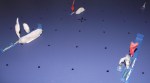
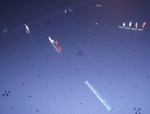
The portions of the Grand and High Seas fleets that were not involved in the Kattegat battle had their own action at the same time. The British 1st and 4th Battle Squadrons, providing distant cover for the Kattegat force, are engaged by the newer German dreadnoughts steaming north from the Jade (Battle Squadron III and Scouting Group I).
Both fleets begin to form battle lines headed east. The top of the photo is north.
A signal sent to the wrong division delays the British deployment. The German dreadnoughts are out of range, so the German battle cruisers take most of the British fire in the early turns.
The rear British division about to turn into line. DDs race to their new stations.
Both fleets have reversed course to the west. St. Vincent and a British CL have blown up. Seydlitz has sunk.
Two British dreadnoughts have veered out of line with steering hits. The westerly wind has favored British shooting.
Close-up of the British fleet passing the wreck of the St. Vincent.
This is the second in a series of hypothetical battles based on the implementation of the strategy suggested by Wolfgang Wegener (“The Naval Strategy of the World War“). For a brief description of the Wegener Thesis, see this article.
After taking the Jutland peninsula, the Germans establish a naval base at Frederikshavn. The British send the battle cruisers remaining operational from the previous battle and a supporting battle squadron into the Kattegat to disrupt German mining efforts.
This is the first of a series of hypothetical battles based on the implementation of the strategy suggested by Wolfgang Wegener (“The Naval Strategy of the World War“).
Having failed to defeat France in the campaign of 1914, the Germans invade Denmark as the first step to achieving a geographical position from which a naval war against Britain can be waged. To support the advance of the army north through the Jutland peninsula, the pre-dreadnought squadrons sortie from Kiel to bombard the southern defenses of Aarhus. British intelligence intercepts allow them to send the battle cruiser squadrons into the Kattegat in response.
After 50 minutes of maneuvering, the British established a favorable position to leeward blocking the German retreat. We called the game at that point since it was getting late. We expected many German ships to be destroyed, unless the British lost battlecruisers to magazine explosions. In any case, the German army would get no naval support at Aarhus.
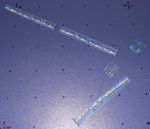
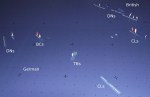
In this hypothetical battle, The German Mediterranean squadron (significantly enlarged from the historical one) is cornered by the British in August 1914.
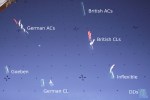
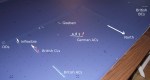
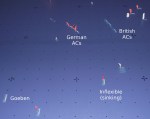
The German squadron heads east out of the Strait of Messina after coaling. Two British battlecruisers pass through the straits and approach from the northwest. Milne, in his flagship Inflexible, approaches from the southeast. The armoured cruisers of the 1st Cruiser Squadron approach from the northeast. The Goeben and the British battlecruisers are limited to 24 knots due to maintenance issues.
The first photo is well into the game. Two German CLs have been sunk and the British CLs have taken a lot of damage.
The two British BCs coming from the west steam at their maximum speed to catch up.
Under fire from four British ACs and two BCs (out of the photo to the west), the German ACs take heavy damage.
Goeben escapes to the south.
The Inflexible is sunk by the Goeben, allowing her to escape to the south with little damage. The German cruisers are all sunk and the British also lose one armoured cruiser.
Milne is posthumously hailed as a hero, and the Goeben reaches Turkey to play her historical role there.
A-H DDs make smoke to cover the deployment of the fleet.
The A-H divisions turn south to get more maneuver room. The French turn north to keep the leeward position. A French AC blows up and another turns out of line with steering damage.
The French take advantage of the good visibility to fight beyond the range of half of the A-H ships.
This scenario was not balanced well due to the French advantage in gun range and the slow speed of the oldest A-H ships.
You must be logged in to post a comment.