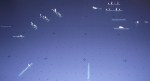
A-H DDs make smoke to cover the deployment of the fleet.
The A-H divisions turn south to get more maneuver room. The French turn north to keep the leeward position. A French AC blows up and another turns out of line with steering damage.
The French take advantage of the good visibility to fight beyond the range of half of the A-H ships.
This scenario was not balanced well due to the French advantage in gun range and the slow speed of the oldest A-H ships.
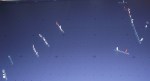
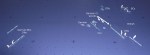
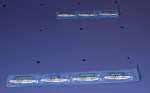
As a counterpart to a recent hypothetical battle where the German battlecruisers were sent into the channel to intercept the BEF transports, this scenario assumes the High Seas Fleet demonstrates in the North Sea to draw the Grand Fleet away from the channel. The GF intercepts the HSF as it moves south along the Danish coast toward the Jade.
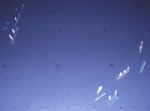
North is to the the left and the Danish coast is off the table to the rear. When sighted, the GF was across the path of the HSF. This photo is several turns later.
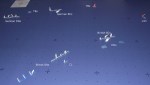
The British dreadnoughts have turned south to avoid German torpedoes. The German dreadnoughts have all taken damage and turned to the west to clear the Danish coast.
A British AC has blown up. British dreadnoughts continue south, chased by German torpedo boats.
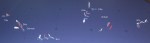
The battle lines attempt to reform, but slower damaged ships start to fall behind.
At the point where we stopped, both battle fleets had taken significant damage and it was expected that a lot more ships would soon be sunk.
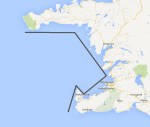
The German Asiatic and Mediterranean squadrons are attempting to return to Germany in September of 1914. Scouting Group I has evaded the British in order to escort them back. While coaling in Faxa Bay Iceland, they are caught by the Battlecruiser Fleet.
German light cruisers were required to stay stationary for the first three turns (15 minutes) and were limited to an ordered speed of 10 knots on turn 4. German heavy ships were required to stay stationary for the first four turns and were limited to an ordered speed of 5 knots on turn 5 and 10 knots on turn 6. The Goben and the three battlecruisers of the 2nd BCS were limited to 22 knots due to maintenance issues.
After the battle in the Fehmarn Belt, the surviving British ships passed through the Kattegat to the Skagerrak. There they were met by the other division of the 2nd Battle Squadron (four Orion class dreadnoughts) and the battlecruiser New Zealand (assigned to the 1st BCS at this time). This force was then intercepted by German ships from Wilhelmshaven.
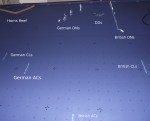
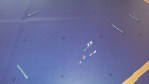
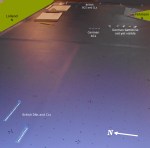
View looking North. The fleets meet just north of Danish coastal waters. Several British ships have damage from the previous battle.
German CLs screen a TB attack and are destroyed. British maneuvers avoid torpedo hits.
The fleets race NW towards the Lion, heavily damaged in the previous battle.
As the range closes, both side accumulate damage. The wind favors the British.
The Lion is protected and the German fleet turns toward home. A course error sends the British DNs straight toward the German guns. The Orion blows up and the Monarch drops out of line.
The German intention to break off is thwarted since several DNs are slowed by flooding.
In June 1914, units of the British fleet were in the Baltic Sea. A division of the 2nd Battle Squadron (four King George V class dreadnoughts) commanded by Vice Admiral Sir George Warrender and three light cruisers were in Kiel, Germany between June 23rd and June 30th. The 1st Battlecruiser Squadron commanded by Rear Admiral Sir David Beatty visited Riga, Revel and Kronstadt, and was in Kronstadt on the 28th when the assassination of Austrian Archduke Ferdinand occurred.
This hypothetical engagement assumes (1) that the Austrian government promptly responded to the assassination with a declaration of war on Serbia, (2) that a state of war existed between Britain and Germany on July 1st, and (3) that the Germans sortied their available ships to intercept the British squadrons before they could exit the Baltic.
The composition of the German force is extrapolated from the ships mentioned in von Hase’s description of the Kiel visit. British light cruisers are assumed to have also accompanied the 1st BCS.
After leaving Kiel, Warrender cruises in the Fehmarn Belt waiting for Beatty to arrive from the east. The 1st BCS leaves Kronstadt on the 29th in order to reach the Fehmarn Belt on July 1st. Beatty is still a Rear Admiral at this point and Warrender will be in overall command when the two forces join.
References:
George M. Nekrasov, “Expendable Glory: Russian Battleship in the Baltic, 1915-1917” [for the presence of the 1st BCS at Kronstadt on July 28th]
Commander Georg von Hase, “Kiel & Jutland” [for details of the Kiel visit and the ships present]
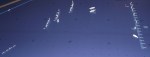
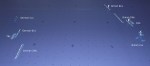
The two British forces have not yet joined when the first German ships are spotted.
The German fleet revealed. Only one dreadnought.
Vice Admiral Warrender reverses course to the east to aid the battlecruisers.
Lion and several German pre-dreadnoughts take damage.
Two British light cruisers are lost and the Lion limps away covered by the British dreadnoughts.
Just as it seems British will get away without major loss, the Audacious is blown up. A German pre-dreadnought sinks, having survived more than her ‘fünf minuten’. A German torpedo boat half-flotilla is destroyed before it can launch torpedoes.
The British head for the Langeland Belt.
The Germans are damaged enough that they are glad to see the British go.












You must be logged in to post a comment.