A group in British Columbia recently ran an interesting naval game using the Steel Fleets rules (facebook link). Although it was a few years beyond what my code is designed for, most of the ships involved were from WW1. I have attempted to recreate the game’s initial conditions and early movements. Since the French had some ex-German ships and the Italians had some ex-Austro-Hungarian ships, the nationalities for those ships were overridden so that French or Italian shells and propellants were used.
Winds East at 10 knots. Sea state 2. Visibility increasing from 16,400 to 20,800 yards over the first 10 minutes.
Having recently made significant modifications to the game code, I used the ‘Run to the South’ phase of Jutland as a test case. Course changes, speeds and formations were followed as closely as practical, given that inputs are only changed every five minutes. The primary source was the signals information in Brooks, although plots from Marder, Campbell, Tarrant and the Naval Staff Appreciation were also used. See the list of references below.
In some cases the game code was unable to reproduce formation changes as they seem to have occurred historically. Two examples follow.
Example 1:
When the IAG (First Scouting Group) turned from their initial northwesterly course at 2:27pm GMT, Brooks Table 5.4 gives these signals: 2.27 Turn together to port to WSW 2.30 Follow in wake of SO’s ship 2.43 Turn together to starboard to WSW and states in the text that after 2.27 Hipper “seems to have headed SW for a time in line ahead.” This is consistent with Map 2 of the Harper Report and with Figure 11 in Tarrant.
It is not clear to me how the steaming order of the unit was maintained through the approximately 200 degree turn. Perhaps the trailing ships slowed, with the last ship slowing the most. The game code made a complete hash of the maneuver, but since the IAG was not in combat the disorder did not matter.
I find it interesting that Marder (map 4) and Campbell (Chart 1) have a different plot for the IAG in this period, with no movement in the southwesterly direction at all.
When the 1BCS and 2BCS (battle cruiser squadrons) turn east in response to the sighting of the IAG, the 2BCS is stationed 3 miles ENE of the 1BCS. Brooks Table 5.9 gives these signals: 3.30 Alter course leading ships together the rest in succession to E, 25 knots 3.34 (to 2BCS) Prolong the line by taking station astern Brooks criticizes Beattly since “… the two weakly armoured battlecruisers were thrust forward three miles closer to the enemy and with no prospect of getting into line with Lion and the 1BCS without some violent maneuvering.” The game code had no serious problem putting the 2BCS in line behind the 1BCS, although with the increase in ordered speed to 25 knots, the 26 knot Indefatigable class ships lagged a few hundred yards behind after their speed loss in the turns. The game code reduces acceleration significantly as a ship nears its maximum speed.
The rest of the exercise played out as expected, up to the point where the High Seas Fleet would have been sighted. The Lion lost a gun, the Derfflinger lost a turret, the Tiger blew up, the 5BS started engaging the IAG and the IAG avoided a torpedo attack.
References: Brooks, John, “The Battle of Jutland,” 2016. Campbell, John, “Jutland An Analysis of the Fighting,” 1986. Marder, Arthur J., “From the Dreadnought to Scapa Flow,” 1978. Schleihauf, William, “Jutland The Naval Staff Appreciation,” 2016. Tarrant, V. E., “Jutland The German Perspective,” 1995.
Winds WSW at 12 knots. Sea state 3. Visibility 23,000 yards.
This scenario was designed to examine the tactical employment of several planned battleship and battle cruiser designs. See this post for the designs of the Austro-Hungarian Porject V and VI classes.
Winds WSW at 5 knots. Sea state 3. Visibility 12 NM.
A-H cruisers lay smoke to cover the weaker rear divisions while their guns are out of range.
The British and French begin to deploy.
A-H battle cruisers were initially positioned to support the light cruiser screen, but that puts them in a dangerous position when the British G3 battle cruisers deploy in their direction.
The British G3 battle cruiser division is disordered in evading torpedoes from the A-H CL screen.
The A-H Project VI battle cruisers rapidly take serious damage from the G3s.
Torpedoes from British destroyers force the A-H Project V battleships to evade.
With the A-H battle cruisers wrecked and the best A-H battleships damaged and in disarray, we called the game. The scenario was unbalanced, due in part to the powerful G3 and N3 classes and the weak (four gun) primary armament of the A-H battle cruiser class. We have yet to come to any conclusions about how to effectively employ divisions with differing speeds.
This scenario was inspired by the Russian attack on a convoy of iron ore sailing from Sweden to Germany described in “After Jutland“, Chapter 6, pages 90-91. The Russian attack group of destroyers has a close cover force of cruisers and a distant cover force of dreadnoughts. The Germans expect the operation and counter with their own cruiser and dreadnought supporting forces.
Winds WSW at 5 knots. Sea state 2. Visibility 6 NM.
Convoy escorts (one armed merchant cruiser and two groups of trawlers) attempt to distract the attacking Russian destroyers.
The escorts make smoke.
The convoy makes smoke and heads south at its best speed of 10 knots.
The convoy is destroyed. The old German cruisers are losing the fight with the Russian cruisers.
German dreadnoughts are sighted.
The Russian dreadnoughts press on southwestward to support their cruisers.
The German dreadnought divisions deploy into a battleline while the Russian dreadnoughts reverse course and head northeast.
Cruisers and destroyers clear the line of fire for the dreadnought action.
With the visibility only 12,000 yards the battlelines close to under 10,000 yards. Hits accumulate rapidly.
The two lead Russian dreadnoughts are overwhelmed by a fortunate series of hits from four German dreadnoughts.
With only two Russian dreadnoughts left to face six relatively intact German dreadnoughts, we called the game. The convoy and most of the German cruisers had been destroyed, but the loss of the Russians dreadnoughts was a high price to pay for meeting the mission objective.
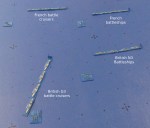
This alternate history scenario was a confrontation between British and French ships in November 1914. The British were tasked with preventing the return of the French fleet from Oran to Toulon. The French were to get underway from the anchorage at Oran and get past the British.









 ncc1717.com
You must be logged in to post a comment.