In this fictional battle using the WWI naval game program, the Russian Baltic fleet sails to attack Kiel in August 1914. The game is continued from the earlier maneuvers posted here. Since the torpedo algorithms were significantly revised, the game was backed up several minutes to restart prior to any significant action.
The plot was complicated, so it was divided into two 20 minute plots:
Looking southwest, with the Germans to the west (right) and the Russians to the east (left).
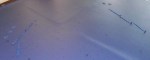
Russian battleships and armored cruisers in the foreground have turned away from a torpedo attack, but are nearing the southern shore of the Fehmarn Belt. The torpedoes miss as a result of the maneuver.
The Russians have reformed into column and head back to the north. In the distance, the Germans have taken torpedo hits on two battleships, seriously damaging them.
Crippled German battleships (red markers) are sent west out of the battle.
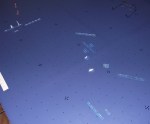
A melee of cruisers, destroyers and torpedo boats between the fleets.
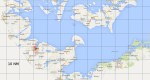
In this fictional battle using the WWI naval game program, the Russian Baltic fleet sails to attack Kiel in August 1914. The Germans scrape together their Baltic forces and meet the Russians in the Fehmarn Belt, in the 10 Nautical mile gap between Fehmarn Island and Lolland Island.
The ships involved were based on Nafziger Collection OBs 914NXAD, 914NIAB, 914NXAA and on this site.
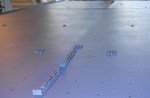
Rurik leads pre-dreadnoughts and armored cruisers with destroyers and a cruiser screen out ahead. The German fleet is in the distance.
Both sides maneuver for position in the narrow Fehmarn Belt. In the foreground are the Russians.
The Germans (left) have come about to engage the Russians on parallel courses.
The maneuvering took a lot of time, as did our discussions of torpedo tactics and game algorithms, so we had to stop just as the shooting started to become effective. Since the program saves the game data each turn, the battle can be continued from any point at the next opportunity.
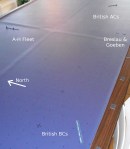
In this fictional battle using the WWI naval game program, the Goeben and the Breslau sail into the Adriatic to join the Austro-Hungarian fleet. They are intercepted by British forces just as the Austrian escort is in sight.
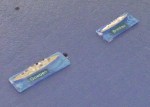
The British armoured cruisers are taking a lot of hits from the secondary guns of the Austrian battleships.
British cruiser squadron before…
… and after.
A-H armoured cruisers before…
… and after.
A-H battleships before…
… and after.
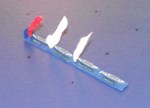
After a running fight lasting 80 minutes, the German ships escape north with little damage. The A-H pre-dreadnought battleships are sunk or sinking, probably to be finished off by the British battlecruisers. The British armoured cruisers have lost one ship and the others are heavily damaged.
In this fictional battle using the WWI naval game program, the fastest units of the High Seas Fleet are sent north to intercept a Scandinavian convoy. The convoy is escorted by the US dreadnoughts serving as the 6th Battle Squadron of the Grand Fleet. Historically, the British had begun escorting these convoys with battleship divisions detached from the Grand Fleet in January 1918. The 6th Battle Squadron sailed to perform this duty for the first time on February 6, 1918 (Jones, “U.S. Battleship Operations In World War I”, Chapter 2).
Derfflinger suffers a steering hit and veers out of formation. In the distance, Texas had taken medium damage.
Damage accumulates on both sides. Lion has blown up, and Renown has fallen out of line.
Texas sinks, Repulse and Tiger blow up. All the Konigs and the three remaining US ships have significant damage.
With the Grand Fleet approaching, the German units have to withdraw. The Markgraf has a maximum speed of 16 knots and will probably be scuttled to avoid capture. New York and Wyoming are so badly damaged that making port will be difficult.
The Austrians round the islands NW of Corfu and the French intercept.
The Austrians turn west and the French reverse course.
The leading French dreadnought is heavily hit and slows, throwing the division into confusion. It also throws the moderator into confusion since he could not remember how to force the code to transfer the division flag.
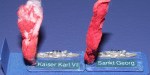
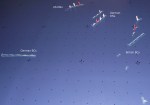
The Austrians dreadnoughts have a lot of guns out of action in the later turns, and SMS Tegetthoff sinks. Yellow and red markers indicate medium and heavy damage.












 ncc1717.com
You must be logged in to post a comment.