Seekrieg 5 – Falklands 1914

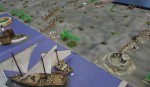
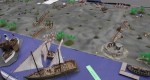
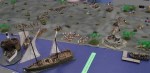
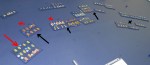
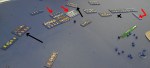
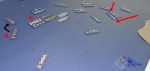
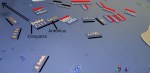
This weekend the local HMGS-South group played a WWI naval game using the Seekrieg 5 rules. The scenario was based loosely on the situation in the Falklands in December 1914, but with significant historical revisions to produce a more balanced battle.

The scenario deviates from history just before von Spee’s squadron reaches the Falklands. Von Spee is alerted to the presence of a strong British force, hides until dawn on 9 December and then uses the cover of fog to start for the Argentine coast. The British divide their forces to search, and one element finds the Germans. The scenario was scaled to give one ship to each of the five players.

Visibility 12,000 yards.

British: battlecruiser Invincible, light cruiser Bristol

German: armored cruisers Scharnhorst and Gneisenau, light cruiser Dresden.

The German ships (especially Scharnhorst) were given an advantage in crew quality to help the scenario balance.

After about 4.5 hours of play, we stopped play. Damage was about even, mostly to Scharnhorst and Invincible. No ship had been sunk or crippled.
 

TSATF – Sudan 1884

This weekend the local HMGS-South group played a Sudan game using The Sword and the Flame colonial rules (20th Anniversary Edition). The scenario was called the Battle of El Sisi Landing, November 13, 1884.

Order of battle and victory conditions: Battle of El Sisi Landing

The British had failed to reach the objective after about five hours of play.

TSATF – Zulu War Scenario

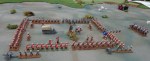
This weekend the local HMGS-South group played a Zulu War game using The Sword and the Flame colonial rules.

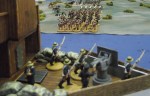
The game was to include a relief column and a besieged force but was cut down to just the relief column due to only having five players. There were 8 British infantry units, 1 cavalry unit, 4 guns and one Gatling gun against 20 Zulu units.The British stayed together, tripped the Zulu ambush with scouts and held their ground well until the last game turn. The Zulu commander choose to bring in all his units except two onto the British left flank.

Edit: More photos taken by one of the players have been added.

The final photo is after the final game turn when the Zulus finally break the British square. A typical TSATF game, the Zulu army is slaughtered but declares victory since they broke a square. The British would have reformed the next turn and what was left of the Zulu army would have been gutted.

Jutland 100th Anniversary – Windy Corner

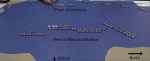
For the 100th anniversary of the battle of Jutland, the positions of the fleets at about 6 pm were set up, and various options for the deployment of the Grand Fleet were discussed.

No formal game was attempted since it would have taken more time than was available, but the capital ships were run through the deployment with automated targeting while we talked. The light forces were mostly ignored, but several torpedo attacks occurred anyway due to the initial courses. Since the German fleet did not turn away, the damage was much greater than historically. The poor visibility, particularly toward the north and east, allowed several devastating torpedo attacks.

Scale: 1/6000 miniatures, 500 yards/in ground scale.

Computer code (described here).

Status at the end of the game: IO Windy

Damage output file: Windy output

Plot of ship movements: sk-plot-Windy


Actium, 31BC

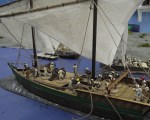
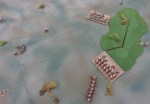
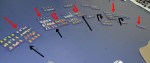
Saturday the local HMGS-South group played a game of Hail, Agrippa!. The Hail, Agrippa! rules are a modification of Hail Caesar published in Issue 66 of ‘Wargames, Soldiers and Strategy’ magazine. [Hail Agrippa! rules link]

The scenario was based on the battle of Actium in 31 BC. The fleet of Marcus Antonius attempts to defeat, or failing that break through, the fleet of Octavius.

Each side lost seven units and the fleet of Octavius was left with more un-shaken units. There was an opening for Antonius and Cleopatra to make their historic escape, but with Octavius dead, Antonius might have gone back to his army and attempted to continue the campaign or negotiate with whoever emerged as the leader of his opposition.