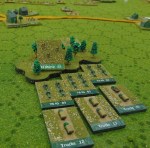
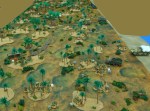
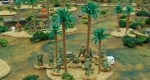
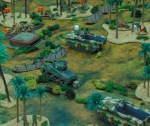
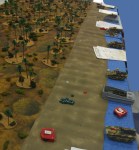
This weekend the local HMGS-South group played a WW2 Eastern Front game using GMT’s Panzer rules. 3mm Pico armor stands and a 1 inch hex grid terrain cloth were used in place of the map and counters. This was a simple tank vs tank meeting scenario to familiarize the group with the rules.
Russians
Germans
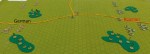
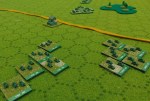
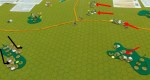
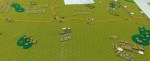
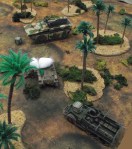
Russians advance on the right. Germans maneuver around the light woods.
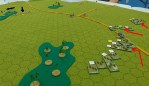
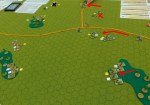
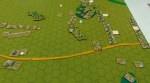
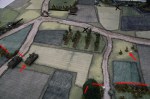
Russian T34/76s occupy woods on the left, but are mostly out of range for their guns.
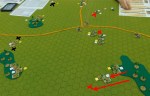
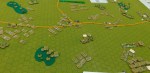
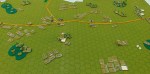
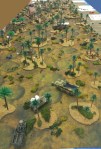
Early firing favors the Russians, but eventually casualties mount on both sides.
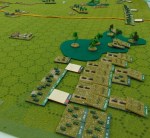
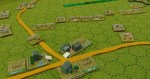
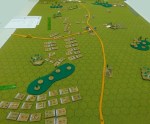
This weekend the local HMGS-South group played a WW2 game using the Spearhead rules and 3mm (Pico) figures.
The Belostock Offensive was part of the third and final phase of the Belorussian Strategic Offensive of the Red Army in summer 1944, commonly known as Operation Bagration. The Belostock Offensive was part of the third, or ‘pursuit’ phase of Operation Bagration, and was commenced after the completion of the encirclement and destruction of much of Army Group Center in the Minsk Offensive.
The scenario was the counterattack that was launched by the 19th Panzer Division against the Soviet 50th Army on July 23rd, 1944 near Grodno.
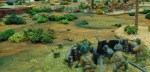
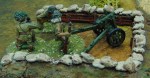
Russian artillery deployed. They rarely answered the phone.
Russian infantry reinforcements arrive.
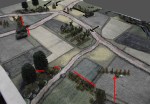
German advance on the center village.
German mechanized infantry sweep around the right.
Massed tank battle when Russian reinforcements enter on the German left flank.
German fire reduces the defenders of the two occupied villages. The village on the left was taken without opposition.
Two Russian brigades (one of T34s, one of SUs) have broken and left the field.
The initial Russian forces were able to deploy in two of the three objective villages. The third village was out of command range. German armor advanced on the German left, expecting the Russian reinforcements on that flank, while infantry attacked the center village and mechanized infantry advanced unopposed on the right. After about 4.5 hours of play, the Russians still had toeholds in the two occupied villages, but no reasonable hope of keeping them or retaking them when lost.
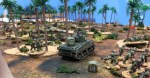
This weekend the local HMGS-South group played a Bolt Action game. This was a similar scenario to the previous Bolt Action game. US Marines landed on a beach defended by the Imperial Japanese Army. Six LVTs, each carrying an infantry squad and several small support units attempted to land in the first wave. Several grounded on a reef for a turn, but by the second turn all troops were safely ashore. Two LVTs were destroyed on the beach by a Japanese tank. The marines and the remaining LVTs moved inland against hidden or dug in defenders. When the game ended the Japanese still held 2 of the 3 objective strong-points.
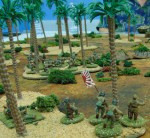
After the initial naval bombardment, the Japanese wait for the landing.
LVTs approach…
… and land the troops.
The left flank LVT is destroyed by the Japanese tank while the Marines use cover to advance.
An LVT survives damage to close with the central Japanese bunker.
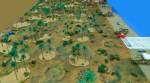
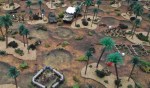
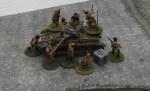
This weekend the local HMGS-South group played a Bolt Action game. This was the largest Bolt Action game the group has played, with about 60 units. US Marines landed on a beach defended by the Imperial Japanese Army.
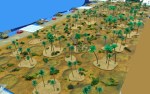
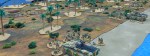
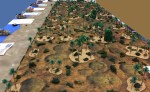
The initial landing.
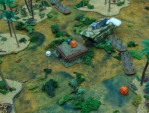
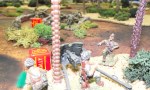
A Japanese AT gun waits in ambush.
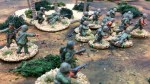
Pins keep some Marine units from advancing.
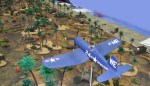
Air support.
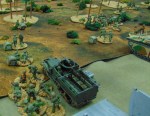
An LVT is destroyed.
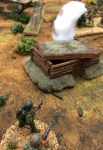
A flamethrower takes out an objective bunker.
A Japanese tank is destroyed from the rear by a heavy MG on a halftrack.
With two of three objective bunkers destroyed and the third under effective artillery fire, the game was ended after seven turns.




 ncc1717.com
You must be logged in to post a comment.