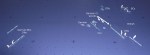
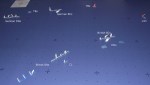
WWI Naval Battle – Fehmarn Belt, July 1914

In June 1914, units of the British fleet were in the Baltic Sea. A division of the 2nd Battle Squadron (four King George V class dreadnoughts) commanded by Vice Admiral Sir George Warrender and three light cruisers were in Kiel, Germany between June 23rd and June 30th. The 1st Battlecruiser Squadron commanded by Rear Admiral Sir David Beatty visited Riga, Revel and Kronstadt, and was in Kronstadt on the 28th when the assassination of Austrian Archduke Ferdinand occurred.

This hypothetical engagement assumes (1) that the Austrian government promptly responded to the assassination with a declaration of war on Serbia, (2) that a state of war existed between Britain and Germany on July 1st, and (3) that the Germans sortied their available ships to intercept the British squadrons before they could exit the Baltic.

The composition of the German force is extrapolated from the ships mentioned in von Hase’s description of the Kiel visit. British light cruisers are assumed to have also accompanied the 1st BCS.

After leaving Kiel, Warrender cruises in the Fehmarn Belt waiting for Beatty to arrive from the east. The 1st BCS leaves Kronstadt on the 29th in order to reach the Fehmarn Belt on July 1st. Beatty is still a Rear Admiral at this point and Warrender will be in overall command when the two forces join.

References:

George M. Nekrasov, “Expendable Glory: Russian Battleship in the Baltic, 1915-1917” [for the presence of the 1st BCS at Kronstadt on July 28th]

Commander Georg von Hase, “Kiel & Jutland” [for details of the Kiel visit and the ships present]


Scale: 1/6000 miniatures, 500 yards/in ground scale.

Rules: Computer code in development.

Visibility 16,000 yards. Wind northwesterly at 14 knots. Seastate 2.

Status at the end of the game: Final status belt3

Damage output file: Belt3 output

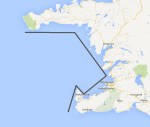
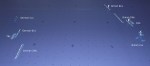
Plot: belt3-plot


WWI Naval Battle – North Sea December 1916

In this hypothetical engagement, the newest units of the Grand Fleet and High Seas Fleet duel in the North Sea.

Scale: 1/6000 miniatures, 500 yards/in ground scale.

Rules: Computer code in development.

Visibility 20,000 yards. Wind northeasterly at 14 knots. Seastate 3.

Status at the end of the game: NS16L final summary

Damage output file: NS16L output

Plot: NS16L plot

The game was ended at this point due to time. A few additional turns were played on the computer. The German dreadnoughts avoided the torpedo attack, although two light cruisers were hit.

Extended output file: NS16L extended

Rapid Fire Photos

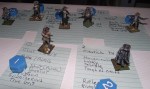
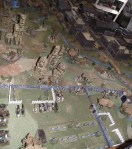
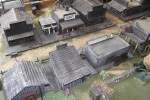
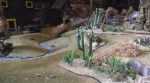
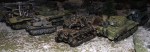
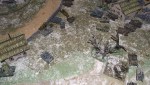
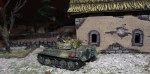
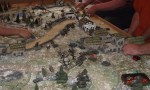
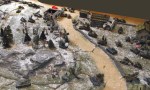
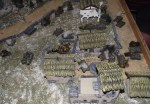
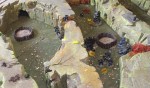
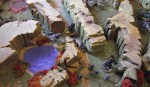
This weekend the local HMGS-South group played a Rapid Fire scenario based on Soviet efforts to retake the Baltic States in the Fall of 1944.

The Russian attacks got near the secondary objective, but German reinforcements were positioned to stop them when we ended the game. A difficult but fun scenario, with lots of tactical choices for the players.


WWI Naval Battle – Gulf of Finland May 1915

In this hypothetical engagement, the Germans send a portion of the High Seas Fleet into the Gulf of Finland in an attempt to engage and destroy the Russian Baltic Fleet.

Scale: 1/6000 miniatures, 500 yards/in ground scale.

Rules: Computer code in development.

Visibility was 18,000 yards. Wind was southerly at 8 knots and the seastate was 2.

Status at the end of the game: Finland End Status

Damage output summary (special damage only – flotation hits not listed): Finland short output

Plots: Finland plot 1  Finland plot 2a


With one pre-dreadnought sunk and several large ships heavily damaged, the Russians give up the game.

Ship of the Line Game Photos

Saturday the local HMGS-South group played a Napoleonic naval game at the Dogs of War shop using Ship of the Line rules and 1/1200 scale miniatures.

A French squadron of one 120, one 80 and five 74s with average crews met a British squadron of six 74s with two elite and four crack crews.


Time brought and end to the game at this point.