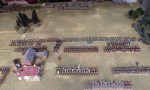
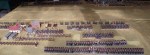
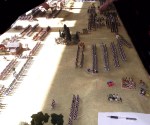
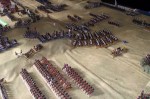
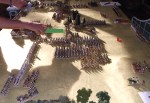
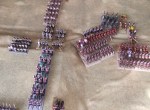
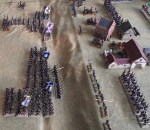
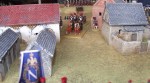
This weekend the local HMGS-South group played a Napoleonic game using Column, Line and Square, Version 2. The scenario was an Allied attack on the French near Probstheyda, south of Leipzig, on 18 October 1813.
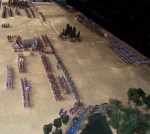
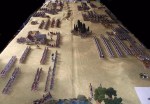
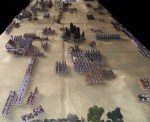
The French are on the left (north). On the right, from top to bottom, are the Prussians, Russians and Austrians.
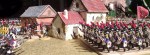
The French right (western) flank with the Austrians in the distance.
The French left deployed on rising ground.
The Allies advance.
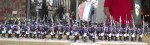
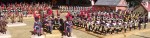
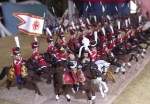
The Emperor and his band.
Additional troops arrive on both sides.
The cavalry clash in the center.
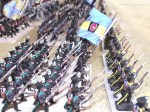
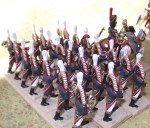
Austrian infantry formations advance.
Austrian lights wipe out the crew of a French battery.
More cavalry clash in the center.
The assault on the French left.
After 4 turns, and the end of the game.
The Allied objective was to take both villages. The French objective was to drive the Allies from the field. When the game was ended due to time, neither side had achieved their objectives.
This weekend the local HMGS-South group played a Bolt Action game. German infantry defend a bridge against Soviet tanks, infantry and mortars. The terrain table was by Real Terrain.
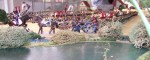
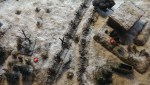
Russians on the left must cross the frozen river to take buildings on the right guarding the bridge.
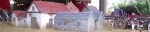
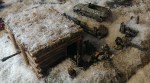
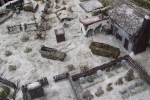
German bunker with AT gun.
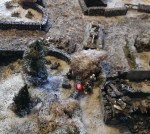
A close range firefight near the bunker results in heavy casualties to both sides.
Russian infantry and a tank cross the bridge, but fail to take the objective buildings.
In spite of their AT gun being blocked by smoke for the entire game, the Germans hold the objectives.
This is the second in a series of hypothetical battles based on the implementation of the strategy suggested by Wolfgang Wegener (“The Naval Strategy of the World War“). For a brief description of the Wegener Thesis, see this article.
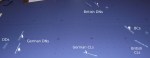
After taking the Jutland peninsula, the Germans establish a naval base at Frederikshavn. The British send the battle cruisers remaining operational from the previous battle and a supporting battle squadron into the Kattegat to disrupt German mining efforts.
This is the first of a series of hypothetical battles based on the implementation of the strategy suggested by Wolfgang Wegener (“The Naval Strategy of the World War“).
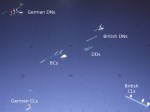
Having failed to defeat France in the campaign of 1914, the Germans invade Denmark as the first step to achieving a geographical position from which a naval war against Britain can be waged. To support the advance of the army north through the Jutland peninsula, the pre-dreadnought squadrons sortie from Kiel to bombard the southern defenses of Aarhus. British intelligence intercepts allow them to send the battle cruiser squadrons into the Kattegat in response.
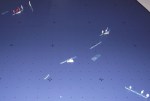
After 50 minutes of maneuvering, the British established a favorable position to leeward blocking the German retreat. We called the game at that point since it was getting late. We expected many German ships to be destroyed, unless the British lost battlecruisers to magazine explosions. In any case, the German army would get no naval support at Aarhus.
This weekend the local HMGS-South group played a Bolt Action game. German infantry and AT guns, reinforced later by a Tiger, defend a crossroads against Soviet tanks, infantry and mortars. Our host provided a great terrain table as usual.
The Soviets in the foreground need to capture buildings around the crossroads at the upper left.
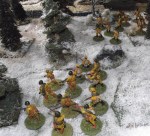
Soviet infantry advance through snowy woods.
Soviet tanks.
Germans hold high ground beyond the crossroads.
A German AT gun is destroyed after taking out just one Soviet tank.
German infantry await a Soviet assault.
A German MG crew and an officer hold off the Soviet left flank.











You must be logged in to post a comment.