A-H DDs make smoke to cover the deployment of the fleet.
The A-H divisions turn south to get more maneuver room. The French turn north to keep the leeward position. A French AC blows up and another turns out of line with steering damage.
The French take advantage of the good visibility to fight beyond the range of half of the A-H ships.
This scenario was not balanced well due to the French advantage in gun range and the slow speed of the oldest A-H ships.
As a counterpart to a recent hypothetical battle where the German battlecruisers were sent into the channel to intercept the BEF transports, this scenario assumes the High Seas Fleet demonstrates in the North Sea to draw the Grand Fleet away from the channel. The GF intercepts the HSF as it moves south along the Danish coast toward the Jade.
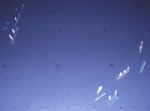
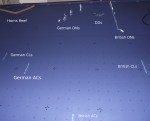
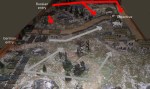
North is to the the left and the Danish coast is off the table to the rear. When sighted, the GF was across the path of the HSF. This photo is several turns later.
The British dreadnoughts have turned south to avoid German torpedoes. The German dreadnoughts have all taken damage and turned to the west to clear the Danish coast.
A British AC has blown up. British dreadnoughts continue south, chased by German torpedo boats.
The battle lines attempt to reform, but slower damaged ships start to fall behind.
At the point where we stopped, both battle fleets had taken significant damage and it was expected that a lot more ships would soon be sunk.
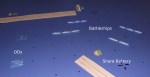
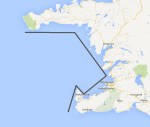
The German Asiatic and Mediterranean squadrons are attempting to return to Germany in September of 1914. Scouting Group I has evaded the British in order to escort them back. While coaling in Faxa Bay Iceland, they are caught by the Battlecruiser Fleet.
German light cruisers were required to stay stationary for the first three turns (15 minutes) and were limited to an ordered speed of 10 knots on turn 4. German heavy ships were required to stay stationary for the first four turns and were limited to an ordered speed of 5 knots on turn 5 and 10 knots on turn 6. The Goben and the three battlecruisers of the 2nd BCS were limited to 22 knots due to maintenance issues.
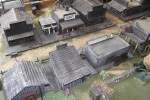
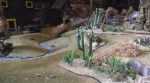
Saturday the local HMGS-South group played a game of Gutshot, in which seven tough gunslingers defended a western town from bandits. We played through the game twice. Each time the town was saved, but not without some highly cinematic deaths among the gunslingers. One player learned that playing with dynamite is dangerous.
The ‘seven’. No, not those seven….
Bandits at the bottom of the photo.
The town-folk are hiding inside. A few will help out in the second game.
In the second game the bandits use more cover in their approach.
Bandits rush into a building. Four have a point blank fight with a gunslinger armed with two sawed-off shotguns. Nobody survives on either side.
One gunslinger is trapped under a fallen horse for a time.
The bandit leader, having sacrificed most of his men, leaves in a rush.
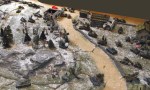
This weekend the local HMGS-South group played a Rapid Fire game. German and Soviet forces, mostly armor, race to take a crossroads and set up AT guns.
The start and the plans.
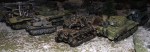
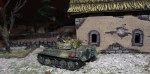
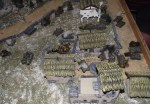
German tanks take up positions using the stone walls for cover.
Tigers lurk, looking for targets.
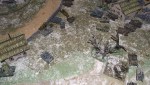
Soviets reach the road across from the German positions and a bloody exchange of fire begins.
Casualties and failed morale checks cause the advantage to shift back and forth.
The Soviets have the crossroads, but have few tanks left. Gunning down the last of the German AT crews wins them the game by a hair.








 ncc1717.com
You must be logged in to post a comment.