This scenario was designed to examine the tactical employment of several planned battleship and battle cruiser designs. See this post for the designs of the Austro-Hungarian Porject V and VI classes.
Winds WSW at 5 knots. Sea state 3. Visibility 12 NM.
A-H cruisers lay smoke to cover the weaker rear divisions while their guns are out of range.
The British and French begin to deploy.
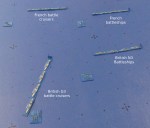
A-H battle cruisers were initially positioned to support the light cruiser screen, but that puts them in a dangerous position when the British G3 battle cruisers deploy in their direction.
The British G3 battle cruiser division is disordered in evading torpedoes from the A-H CL screen.
The A-H Project VI battle cruisers rapidly take serious damage from the G3s.
Torpedoes from British destroyers force the A-H Project V battleships to evade.
With the A-H battle cruisers wrecked and the best A-H battleships damaged and in disarray, we called the game. The scenario was unbalanced, due in part to the powerful G3 and N3 classes and the weak (four gun) primary armament of the A-H battle cruiser class. We have yet to come to any conclusions about how to effectively employ divisions with differing speeds.
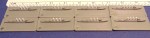
These are eight scout cruisers completed in 1905 and modeled in 1/6000 scale.
From Conway’s All the World’s Fighting Ships 1860-1905, pages 84-85:
“These eight cruisers were intended to work in company with destroyers as scouts, to lead torpedo attacks and to back up their flotillas when attacked by enemy destroyers. The Admiralty provided a broad specification …. for a 25kt ship, with a 1-1/2 inch protective deck or equivalent side armour, shallow draught … 10-12pdr, 8-3pdr and 2TT. …[This] resulted in four sub-classes … that varied substantially in form, machinery and structure. … During 1911/12 they were rearmed with 9-4in guns.”
This scenario was inspired by the Russian attack on a convoy of iron ore sailing from Sweden to Germany described in “After Jutland“, Chapter 6, pages 90-91. The Russian attack group of destroyers has a close cover force of cruisers and a distant cover force of dreadnoughts. The Germans expect the operation and counter with their own cruiser and dreadnought supporting forces.
Winds WSW at 5 knots. Sea state 2. Visibility 6 NM.
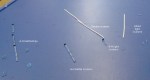
Convoy escorts (one armed merchant cruiser and two groups of trawlers) attempt to distract the attacking Russian destroyers.
The escorts make smoke.
The convoy makes smoke and heads south at its best speed of 10 knots.
The convoy is destroyed. The old German cruisers are losing the fight with the Russian cruisers.
German dreadnoughts are sighted.
The Russian dreadnoughts press on southwestward to support their cruisers.
The German dreadnought divisions deploy into a battleline while the Russian dreadnoughts reverse course and head northeast.
Cruisers and destroyers clear the line of fire for the dreadnought action.
With the visibility only 12,000 yards the battlelines close to under 10,000 yards. Hits accumulate rapidly.
The two lead Russian dreadnoughts are overwhelmed by a fortunate series of hits from four German dreadnoughts.
With only two Russian dreadnoughts left to face six relatively intact German dreadnoughts, we called the game. The convoy and most of the German cruisers had been destroyed, but the loss of the Russians dreadnoughts was a high price to pay for meeting the mission objective.
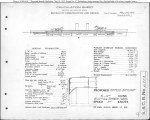
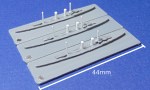
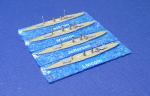
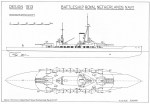
This is a Dutch dreadnought design from 1913, modeled in 1/6000 scale. Various designs were proposed from 1912 through 1914, as described in Warship International No. 4, 1988, No. 1, 1989 and No. 4, 1989. The 1913 quadruple turret design was chosen because it differed the most from contemporary German designs.









 ncc1717.com
You must be logged in to post a comment.