This Friday we played a fictitious naval battle set in the North Sea in 1916. The British attempt to sweep the Heligoland Bight to eliminate German patrols. The Germans are supporting their light forces with heavy ships. The scenario includes ships not actually available in the North Sea at the time.
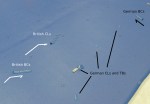
Initially only the 3rd British BCS and its CL screen enter the Bight.
When German BCs are engaged, the remaining British forces move in from the north.
Heligoland in 1/18000 scale (the game’s ground scale)
We played for about 4 hours without a decisive result. The British had suffered somewhat more damage. In spite of a lot of torpedo fire from the light cruisers and destroyers, the only two torpedo hits were achieved by the Von der Tann and the Blucher.
This weekend the local HMGS-South group played a Russo-Japanese War naval game using the Seekrieg 5 rules. The scenario included battleships from the Battle of Tsushima.
The battle was fought in calm seas and hazy weather, visibility 12,000 yards. The lead ships started about 12,000 yards apart.
Japanese ships in a single line ahead:
Mikasa, Asahi, Fuji, Shikishima, Chin Yen
Russian ships in two divisions, each in line ahead:
Kniaz Suvarov, Imperator Alexander III, Borodino, Orel
Oslyabya, Sissoi Veliki, Navarin, Imperator Nicolai I
Crew quality was randomized, with the Japanese having a probable advantage:
Japanese:
1-20% +1
21-80% +2
81-100% +3
Russian:
1-30% -1
31-90% 0
91-100% +1
The battle opened with the Borodino class ships firing at the four new Japanese battleships, the Oslyabya firing at the Chin Yen and the four Japanese battleships firing on the lead pair of each Russian division. The guns of the remaining ships would be out of range for several turns. The Japanese soon switched to firing their primary guns on the four Borodino class and their secondary guns on the older Russian ships. The Imperator Alexander III lost an engine room on the first turn, forcing her to leave the formation. That was the story for the rest of the battle, with the Russian first division taking most of the damage.
After 14 turns and more than four hours of real time, the damage was:
Russian:
Kniaz Suvarov 3 tiers, speed reduced to 7 knots
Imperator Alexander III 1 tier, speed reduced to 9 knots
Borodino light damage
Orel 8 tiers, speed reduced to 11 knots,
– no main battery, sinking
Oslyabya light damage
Sissoi Veliki light damage
Navarin light damage
Imperator Nicolai I light damage
This weekend the local HMGS-South group played a fictitious naval battle set in the North Sea in May 1914. The British attempt to destroy the German fleet in the North Sea bases. The German fleet sails to fight in the Heligoland Bight. The scenario is based on the British strategy of destroying fleets which may become a threat (Copenhagen) (also), and the German concept of the Risikoflotte (risk fleet).
Most of both side’s dreadnoughts have been spotted.
Both fleets have deployed into lines and approach on courses giving reasonable range rates. The head of the German line takes early damage and the rear is disrupted by British flotilla torpedo attacks. Those flotillas take heavy damage.
After more than four hours of play and 60 minutes of game time we called it a day. 5 British dreadnoughts were sunk and 2 were in a sinking condition. 2 German dreadnoughts were sunk and 1 was heavily damaged. The Germans could claim a tactical victory at this point but not a strategic victory.
This weekend the local HMGS-South group played a fictitious naval battle set in the North Sea during the Russo-Japanese War.
The Russo-Japanese War has been in progress since 1904. Historically, the Franco-Russian Alliance of 1894 did not require France to support Russia since no Triple Alliance member state was involved. The Anglo-Japanese Alliance of 1902 did not require Britain to support Japan since Japan was not at war with more than one state.
In this somewhat altered history, Germany has decided to spend money on the army and not build a large fleet. Anglo-German relations are good. France finds it necessary to support Russia due to the military balance in Europe. Japan, assuming that this is the case, attacks French assets in Asia. Thus France and Russia are at war with Japan and the Anglo-Japanese Alliance (Article 3) is invoked.
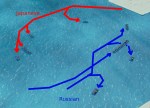
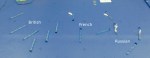
Each player had to give initial orders based only on seeing two clouds of smoke on the horizon.
The British maneuver to the east to get the leeward position. The Russian and French attempt to coordinate without being able to communicate.
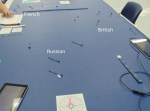
The French have placed themselves between the British and the Russians.
The British concentrated their fire on the Russian ships and damaged all four of the Borodino class (the most valuable Russian ships). The French placed themselves between the British and the Russians. The Russians fought on, declining to leave the French to fight alone against a much larger British force. After about 3.5 hours of play and 70 minutes of game time, many of the heavy ships were low on ammunition. A minor British win perhaps, but all sides acquitted themselves well.
This weekend the local HMGS-South group played a fictitious naval battle set in the Adriatic in WW1. On June 15, 1915, a few weeks after the Italian declaration of war on Austria-Hungary, the Austro-Hungarian fleet sails to attack Brindisi and to lure out the Italian fleet. The Italians are alerted and hope to avenge Lissa.
Visibility 14,000 yards. Wind WSW at 10 knots. Seastate 2.
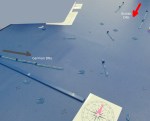
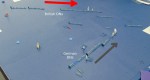
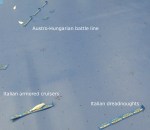
The rear divisions of each fleet are not yet in sight and not on the table.
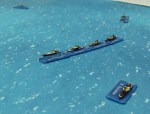
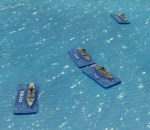
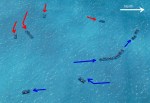
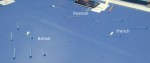
Both sides manage torpedo launches at the opposite battle lines.
Markers indicate visible torpedo launches.
After four hours of play we ended the game with the Austro-Hungarians having lost 2 battleships and all their destroyers and the Italians having lost most of their destroyers. Several cruisers on both sides were badly shot up.







 ncc1717.com
You must be logged in to post a comment.