The scenario is set in Year 170F. The Lyrans and Klingons have just captured the Hydran Capital. The surviving Hydran forces are in a disorganized retreat to the Old Colonies but secondary Lyran forces are in position to attack the retreating forces.
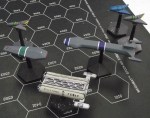
The Hydrans start with a Large Freighter at 0303 trying to cross the map to exit between 4201-4210.
The Hydran guard force of a Traveller Light Cruiser, a Knight Destroyer and a Hunter Frigate can set up anywhere within 4 hexes of the freighter. The guard force has already seen combat and the cruiser and destroyer start with 12 random damage each. The guard force has already lost all of its fighters and has not been resupplied. The guard force only has half of its transporter bombs.
A Hydran police ship Gendame has been following and reporting the location of the Lyran force and arrives as reinforcement Turn 2 near 1532 and at least 10 hexes from any Lyran ships. The Gendame does have its fighters.
The Lyran force of a Light Cruiser, a War Destroyer, a Destroyer and a Frigate starts within 3 hexes of the 0132 corner. Being a secondary force it only has half of its transporter bombs.
Victory conditions are standard (but the freighter is worth twice its economic value)
Hydrans
Lyrans
An Orion ship substituting for the Hydran police ship.
The Lyran war destroyer takes damage at close range from the Hydran frigate.
The Hydran light cruiser is reduced to a hulk by concentrated Lyran fire.
Lyran ships concentrate on the freighter.
The freighter is left without power.
After two turns, the Lyrans have achieved victory by preventing the escape of the freighter.
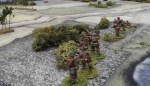
This weekend the local HMGS-South group played a Bolt Action game.
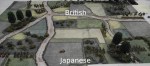
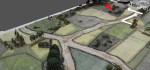
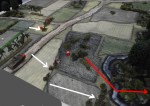
The Envelopment Scenario in the Bolt Action rule book was used. It was based on the fighting around the city of Kohmia in May 1944, between the British 2nd Division and the Japanese 15th Division. The Japanese were attempting to envelop a British position and capture a road junction behind the British lines.
The Japanese will get the most victory points for exiting units off the table behind the British lines.
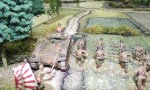
Only one vehicle was used.
The thin red line.
Japanese troops advance rapidly all across the front.
The center units exchange fire with the British while the flank units continue to advance. Most of the early fire fights were on the Japanese center and right.
The Japanese left turns the British flank using a low hill for cover.
Units begin exiting the table. Two British squads are destroyed, one by a Banzai charge.
The tank is confined to the roads, so moves right to support the infantry assault there.
After a stalwart defense, the British left flank is driven off.
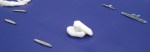
This weekend the local HMGS-South group played a WWI naval game using the Seekrieg 5 rules. The scenario was based loosely on the situation in the Falklands in December 1914, but with significant historical revisions to produce a more balanced battle.
The scenario deviates from history just before von Spee’s squadron reaches the Falklands. Von Spee is alerted to the presence of a strong British force, hides until dawn on 9 December and then uses the cover of fog to start for the Argentine coast. The British divide their forces to search, and one element finds the Germans. The scenario was scaled to give one ship to each of the five players.
German: armored cruisers Scharnhorst and Gneisenau, light cruiser Dresden.
The German ships (especially Scharnhorst) were given an advantage in crew quality to help the scenario balance.
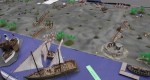
The opponents are just coming into sight, having been hidden by the fog-shrouded headlands. A Lion class model is standing in for the Invincible.
On the left, Dresden leaves the formation and heads toward the Bristol using evasive maneuvering. On the right, the Bristol opens the range. The Invincible is beyond the visibility limit of 12,000 yards.
All ships are accelerating at their maximum rate. The Germans close, presenting a bow aspect.
Due to the poor visibility, most of the early fire is ineffective.
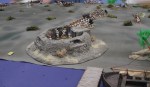
The fog bank blocks fire.
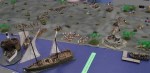
The blue stones indicate ships under fire for calculating over-concentration penalties.
Invincible turns to cross the German T.
… and keeps turning to close to point-blank range of Scharnhorst.
Positions at the close of the game. Scharnhorst is on fire.
After about 4.5 hours of play, we stopped play. Damage was about even, mostly to Scharnhorst and Invincible. No ship had been sunk or crippled.
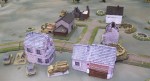
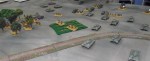
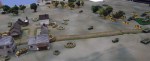
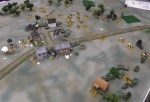
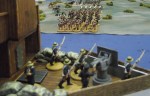
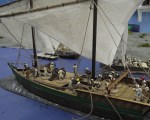
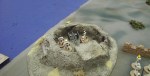
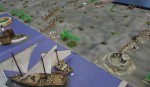
This weekend the local HMGS-South group played a Sudan game using The Sword and the Flame colonial rules (20th Anniversary Edition). The scenario was called the Battle of El Sisi Landing, November 13, 1884.

















You must be logged in to post a comment.