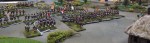
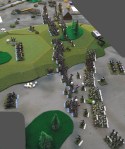
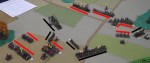
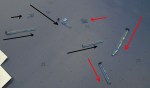
Saturday the local HMGS-South group played a Napoleonic game using a modified version of the Empire V rules. The game pitted two corps (four divisions) of French against a similar force of Austrians.
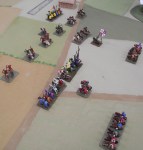
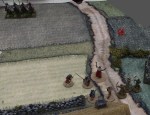
The Austrian division on the left flank advances.
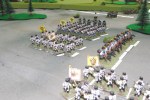
The Austrian center right in the foreground.
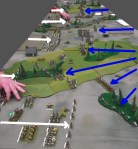
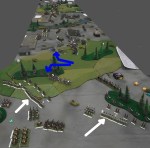
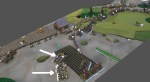
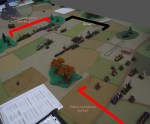
The Austrian right flank division is ordered toward a small woods. The French division opposite occupies that woods and most of the raised ground on this end of the battlefield.
The French center left division advances to meet the oncoming Austrians.
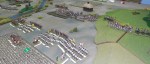
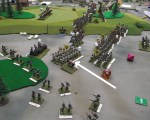
Infantry firefights break out along the length of the front.
The Austrian right flank division pivots to face the advancing French.
French infantry units break and the Austrian left flank advances toward French a battery
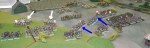
Austrian infantry advances on French guns in the center.
An Austrian division leaves the field.
French units advance into the void and move to overwhelm the Austrian right flank division.
The French success on their left seemed more significant than their losses on their right, but overall a closely fought battle.
This weekend the local HMGS-South group played a Hail Caesar game. The fictitious encounter was set after the battle of Grunwald (or Tannenberg) in 1410. Surviving Teutonic Order forces are attempting to escape to the west. Polish–Lithuanian Union forces block the retreat while others arrive in the rear.
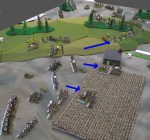
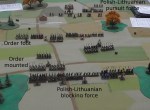
The mounted Order units attack the blocking force while the foot units block the pursuit.
Several command roll blunders hinder the pursuit force.
Top right: Order knights are fought to a standstill by Polish infantry. Polish Knights all but destroy an Order mounted division.
The Order attack to the west has failed and the Polish knights are finally ready to charge the Order foot.
The confused battle lines at the end.
After about four hours of play the casualties were about even but very heavy. The remaining Order units seemed to have no chance of getting safely to the west.
This weekend the local HMGS-South group played a World War One naval game based on this March 9th 1915 memo (item 121 Jellicoe Papers) from the 1st Lord of the Admiralty. The idea was to send a fast division into the Baltic Sea and, in cooperation with the Russian fleet, blockade German ports. The Germans send the ships that were in the Baltic for training exercises.
The light cruiser screens have engaged. A data entry error by the twit running the game (me) resulted in one British cruiser division driving through the German fleet.
The forces close, but frequent course changes, smoke and high speeds keep hits low.
The heavy ships passed by at close range, resulting in the loss of a British dreadnought, a British battlecruiser and a German battlecruiser.
The Russian Pacific Squadron of 1904 in 1/6000 scale. The paint schemes are loosely based on this advice. The darker hull colors have been lightened to contrast more with the ships of the 1905 squadron.
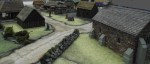
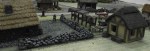
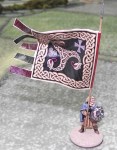
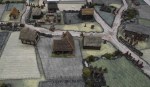
This weekend the local HMGS-South group played a game of Pig Wars. The scenario was set around the sleepy little village of Chelsea, located somewhere on the east coast of Britain, sometime after the Romans left, but before the Norman conquest (history can be so fuzzy on these events).
A sleepy village in Britain….
The local priest watches over his flock.
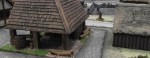
The market ready for a day of peaceful barter.
The market stalls are looted.
The ox wagons plod through the village unhindered, thanks to careful diplomacy.
Something frightful in the village church scares off the potential looters, so they burn it.
The Norman foot is eliminated and the mounted warriors beat a temporary retreat.
Retreating with the loot.
Two bands fight it out until one is eliminated.
In the end a couple of the players met their primary objectives and one left town with substantial loot.












 ncc1717.com
You must be logged in to post a comment.