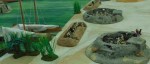
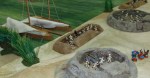
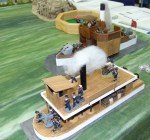
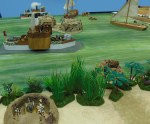
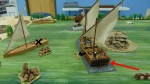
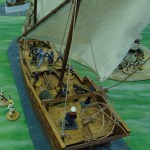
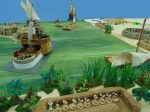
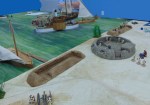
This weekend the local HMGS-South group played a Sudan game using The Sword and the Flame colonial rules (20th Anniversary Edition) and the Gunboats and Dhows rules. Two river steamers manned by the Royal Navy were tasked with capturing two small Dhows docked on the Nile. Fortifications covered the approaches to the docks and additional Ansar troops arrived by boat. The boats used were made by Last Stand Dan.
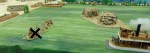
The Dhows are initially unmanned.
The British arrive.
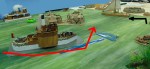
A large Dhow appears suddenly to block the British advance…
… and is quickly sunk. The crew eventually makes it to shore.
One of the small Dhows gets underway.
A second large Dhow appears and blows up a British steamer with a lucky hit.
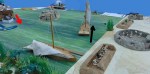
A hidden Ansar gun fires with little effect, and is quickly silenced.
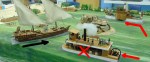
Most of the British crew survives the explosion of their boat and captures the opposing Dhow. The Ansar crew of the small Dhow is wiped out.
A second hidden fort fires, but causes few British casualties.
The empty small Dhow is captured by the British.
The British captured one large and one small Dhow, sank a large Dhow and destroyed several Ansar forts. One British steamer was destroyed, but otherwise British casualties were light.
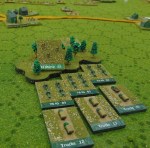
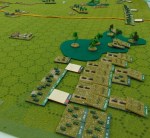
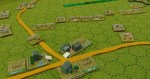
This weekend the local HMGS-South group played a WW2 game using the Spearhead rules and 3mm (Pico) figures.
The Belostock Offensive was part of the third and final phase of the Belorussian Strategic Offensive of the Red Army in summer 1944, commonly known as Operation Bagration. The Belostock Offensive was part of the third, or ‘pursuit’ phase of Operation Bagration, and was commenced after the completion of the encirclement and destruction of much of Army Group Center in the Minsk Offensive.
The scenario was the counterattack that was launched by the 19th Panzer Division against the Soviet 50th Army on July 23rd, 1944 near Grodno.
Russian artillery deployed. They rarely answered the phone.
Russian infantry reinforcements arrive.
German advance on the center village.
German mechanized infantry sweep around the right.
Massed tank battle when Russian reinforcements enter on the German left flank.
German fire reduces the defenders of the two occupied villages. The village on the left was taken without opposition.
Two Russian brigades (one of T34s, one of SUs) have broken and left the field.
The initial Russian forces were able to deploy in two of the three objective villages. The third village was out of command range. German armor advanced on the German left, expecting the Russian reinforcements on that flank, while infantry attacked the center village and mechanized infantry advanced unopposed on the right. After about 4.5 hours of play, the Russians still had toeholds in the two occupied villages, but no reasonable hope of keeping them or retaking them when lost.
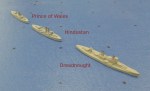
This weekend the local HMGS-South group played a WWI naval game using the Seekrieg 5 rules. The year is 1906. The British have just completed a new battleship. Navel experts claim it makes every other battleship obsolete. HMS Dreadnought and two British pre-dreadnoughts take on six German pre-dreadnoughts.
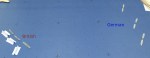
There is land off the bottom of this photo, so both forces will need to reverse course. The initial range is about 24,000 yards.
The Germans: three players with two ships each.
The British: two players with one commanding the Dreadnought and one commanding the two prdreadnoughts.
The British turn away to keep the range from falling.
Turning to avoid the land.
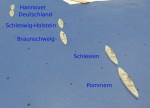
The Germans attempt to shorten the range at the expense of masking their after turrets.
The Pommern falls behind after hits from Dreadnought reduce her speed.
Braunschweig falls behind when two engines take temproary damage. Dreadnought’s speed falls to 17 knots due to boiler damage.
Deutschland is slowed by engine and boiler damage.
After about 4 hours of play and 20 game turns (40 minutes) we called the game. Damage results:
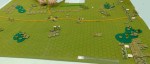
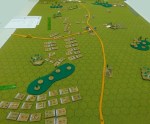
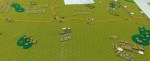
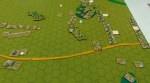
This weekend the local HMGS-South group played a Black Powder Civil War game. The scenario was loosely based on the Battle of Piedmont, June 5th, 1864.
Black Powder rules modifications: BP-ACW specific rules (distances were adjusted for a ground scale of 50 yards per inch)
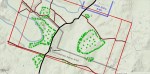
The river and hill terrain was based on Google Map terrain.
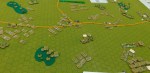
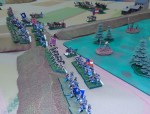
The main Confederate position.
Barricades of felled trees protect some of the troops.
The Union advance with most of the artillery in the center, infantry brigades on each side and cavalry on the far left.
Union cavalry moving fast in march column are charged by Confederate cavalry. One Union regiment is destroyed.
The Union guns destroy a Confederate battery while the Union infantry advances.
The Union infantry attack goes in.
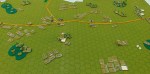
Union cavalry and infantry gradually push back the Confederate right wing.
A Union regiment is broken by canister fire and another retreats. The second Union line charges in.
The Union assault on the barricades has failed, and the Confederate line shifts to face the threat to their right.
A Confederate battery is charged in the flank.
Union cavalry massed for an attack on the remaining Confederate cavalry.
After four hours of play we called the game. The Union took heavy casualties to their largest brigade, the Confederates lost two batteries and cavalry losses were about even.
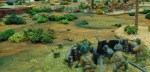
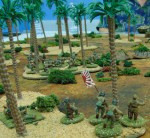
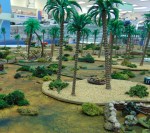
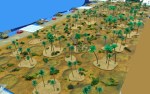
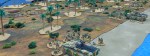
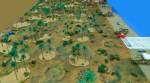
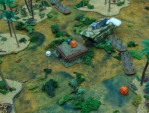
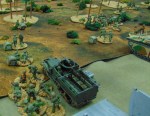
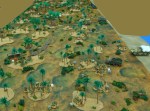
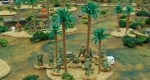
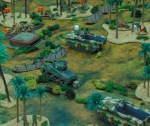
This weekend the local HMGS-South group played a Bolt Action game. This was a similar scenario to the previous Bolt Action game. US Marines landed on a beach defended by the Imperial Japanese Army. Six LVTs, each carrying an infantry squad and several small support units attempted to land in the first wave. Several grounded on a reef for a turn, but by the second turn all troops were safely ashore. Two LVTs were destroyed on the beach by a Japanese tank. The marines and the remaining LVTs moved inland against hidden or dug in defenders. When the game ended the Japanese still held 2 of the 3 objective strong-points.
After the initial naval bombardment, the Japanese wait for the landing.
LVTs approach…
… and land the troops.
The left flank LVT is destroyed by the Japanese tank while the Marines use cover to advance.
An LVT survives damage to close with the central Japanese bunker.

 ncc1717.com
You must be logged in to post a comment.