Klingon Frigates

These are Amarillo Design Bureau Starline 2500 series ‘Klingon E4 Light Frigates‘ cast in metal several years ago. At 36 mm in length, they are much larger than my old escorts. They will be used for a class intermediate in size between my F5s and D7s. The E4s and F5s will thus be reversed by size, but that avoids re-labeling all the old models.

Decals on new ships are from Mark’s Models and Toys.

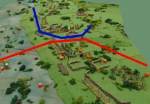
Bolt Action – Edson’s Ridge

This weekend the local HMGS-South group played a Bolt Action game.  The scenario was based on the second night of the Battle of Edson’s Ridge, which occurred on the night of 13-14 September 1942. The ridge was part of the defenses of Henderson Field, Guadalcanal. This game involved the position of the 1st Marine Raider Battalion, attacked by Kokusho’s and Tamura’s battalions of the Japanese 124th Infantry Regiment.


HeroClix Klingon Battlecruisers

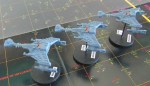
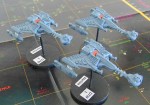
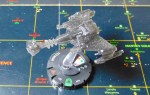
These are Star Trek HeroClix I.K.S. Amar models (from the Tactics IV set), after painting and rebasing. Compared to the normal HeroClix Klingon battlecruisers, they have extra bits sticking out from the front of the wings and from the neck, as well as other differences in detail. In most Star Trek lore the Amar is the quintessential K’t’inga class. The card that came with these models mentions the Kelvin Timeline, so that may explain the differences.

The third photo shows the unpainted Amar on the original HeroClix base.

Course Calculation for Constant Range – 1913

In October 1913, Chatfield (Beatty’s flag captain) wrote a memorandum entitled “Fast Division Work from a Gunnery Standpoint” (The Beatty Papers Vol I, Item 49, page 90). This memorandum included the following statements about changes in gunnery range:

“… the attempt to obtain a tactical, or rather a gunnery advantage, usually results in a high and frequently changing rate due to constant change of course. This must affect the gun fire, possibly … to such an extent as to entirely neutralize the value of the position gained.”

“… it is quite easy, with superior speed, to calculate suitable courses which will keep the range constant and the rate nil …”

“The T must never be crossed at too broad an angle as this is unnecessary and causes a big and difficult rate.”

Two examples are given in the memorandum for a fast division speed 5 knots greater than the enemy. Both are apparently wrong and were corrected in notes added by Beatty. Also, specifying only the difference in speed is insufficient. The solution for 10 knots and 15 knots (for example) would be significantly different from the solution for 20 knots and 25 knots.

The following diagram shows the problem in a general form, where:

Ao Angle before the beam of the enemy
De Distance traveled by the enemy unit over the time interval
Df  Distance traveled by your unit over the time interval
R   Range to the enemy unit
A   Angle to steer toward enemy

Although Chatfield says he can calculate ‘perfect gunnery courses’, the range is not precisely constant over the time interval. It is only the same at the start and end points. Line Df would need to be a curve (implying a continuous change of course) to keep the range constant at all times.

A general solution to the problem can be developed by using the Law of Cosines. The area swept by the fire range is divided into two triangles:

To keep the formulas to a manageable size, intermediate terms are calculated:

Tables for various combinations of speeds, ranges and angles can be created: