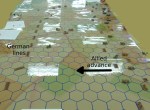
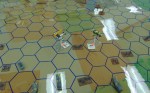
This weekend the local HMGS-South group played a game of GDW’s Blue Max (first edition 1983) using 1/144 scale planes from the Wings of War series. The scenario was an Allied advance in the spring of 1918. A few rules were added to cover attacks on ground units and anti-aircraft fire. Five players (two German, three Allied) each flew one plane, and got a replacement if they were downed or left the table.
The photos suffer from reflections from the clear vinyl hex sheet.
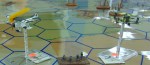
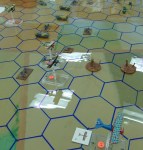
An S.E.5a’s wings are shredded in a pass with a D.VII. Return fire and ground fire sets the D.VII alight.
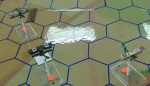
Two French infantry units like the one here will eventually be scattered by fire from another D.VII.
A Dr.I occupied the other two Allied planes (a Spad XIII and a S.E.5a).
Several planes end up low or out of fuel.
Both German and one Allied plane left the table damaged and low on fuel and were replaced. One S.E.5a exploded. We played 28 turns in about 3.25 hours.
This weekend the local HMGS-South group played a fictitious naval battle set in the North Sea during the Russo-Japanese War.
The Russo-Japanese War has been in progress since 1904. Historically, the Franco-Russian Alliance of 1894 did not require France to support Russia since no Triple Alliance member state was involved. The Anglo-Japanese Alliance of 1902 did not require Britain to support Japan since Japan was not at war with more than one state.
In this somewhat altered history, Germany has decided to spend money on the army and not build a large fleet. Anglo-German relations are good. France finds it necessary to support Russia due to the military balance in Europe. Japan, assuming that this is the case, attacks French assets in Asia. Thus France and Russia are at war with Japan and the Anglo-Japanese Alliance (Article 3) is invoked.
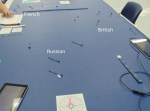
Each player had to give initial orders based only on seeing two clouds of smoke on the horizon.
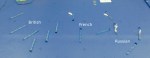
The British maneuver to the east to get the leeward position. The Russian and French attempt to coordinate without being able to communicate.
The French have placed themselves between the British and the Russians.
The British concentrated their fire on the Russian ships and damaged all four of the Borodino class (the most valuable Russian ships). The French placed themselves between the British and the Russians. The Russians fought on, declining to leave the French to fight alone against a much larger British force. After about 3.5 hours of play and 70 minutes of game time, many of the heavy ships were low on ammunition. A minor British win perhaps, but all sides acquitted themselves well.
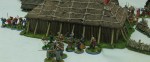
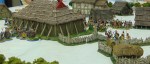
This weekend the local HMGS-South group played a SAGA game. Consistent with the recent weather in Britain, the game was played on snow-covered ground. Each side had one battle board and shared the available activations and actions among the players.
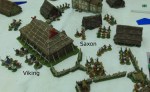
Saxons organize their men.
Both sides enter the village.
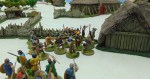
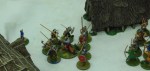
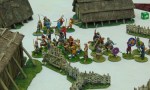
Berserkers attack the Saxon warlord and his men. The Vikings are all killed in the melee. The Saxon warlord would prove to be impervious throughout the battle.
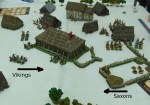
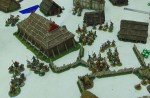
Vikings attack via two routes.
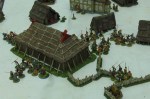
The victorious Saxons hold their ground.
Casualties were high on both sides, but in the end the Saxons had repelled all the Viking attacks and were declared the victors.
Baker Company of the 8th RCT, 4th Infantry Division is pushing inland to the town of St-Marie-du-Mont. However, the route to the town is blocked by the Germans of the 2nd Company, 919th Infantry Regiment. The Germans have placed a PAK 40 ATG to cover the road and dug in around a cluster of farm buildings. The PAK has already knocked out the leading M4 Sherman of Baker Company’s armor support. The scenario begins with Baker Company deployed for a full assault against the German positions.
This used the Attack/Defense scenario. The American point total was around 500, the German around 250 points.
No photos were taken due to the poor memory of the photographer.
We played 7 turns of the 8 turn scenario in about four hours. The Americans had not reached the objective bridge and had lost their light vehicles and some infantry. The Germans had lost about half their units and the outer defense line was gone.






You must be logged in to post a comment.