Jutland 100th Anniversary – Windy Corner

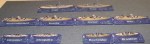
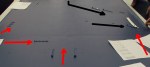
For the 100th anniversary of the battle of Jutland, the positions of the fleets at about 6 pm were set up, and various options for the deployment of the Grand Fleet were discussed.

No formal game was attempted since it would have taken more time than was available, but the capital ships were run through the deployment with automated targeting while we talked. The light forces were mostly ignored, but several torpedo attacks occurred anyway due to the initial courses. Since the German fleet did not turn away, the damage was much greater than historically. The poor visibility, particularly toward the north and east, allowed several devastating torpedo attacks.

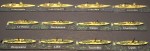
Scale: 1/6000 miniatures, 500 yards/in ground scale.

Computer code (described here).

Status at the end of the game: IO Windy

Damage output file: Windy output

Plot of ship movements: sk-plot-Windy

 

WWI Naval – Gulf of Finland

This weekend the local HMGS-South group played a WWI naval battle. In this hypothetical engagement, the Germans send a portion of the High Seas Fleet into the Gulf of Finland in an attempt to engage and destroy the Russian Baltic Fleet. The date is March 15, 1915. The scenario is similar to a previous test.

Scale: 1/6000 miniatures, 500 yards/in ground scale.

Rules: Computer code (described here).

Visibility 16,000 yards. Wind southerly at 8 knots. Seastate 2.

Status at the end of the game: Fin2-end-status

Damage output file: SK-Normal-Fin2-2016-1-23 excerpt.txt

Plot of ship movements:
All Fin2-plot-all
First 20 minutes Fin2-plot-1to20
20 minutes to 40 minutes Fin2-plot-20to40
40 minutes to end Fin2-plot-40toend

We quit at this point due to time. The damage was relatively even. The Russian destroyers and torpedo boats and the German light cruisers did most of the fighting. One dreadnought had been sunk on each side.

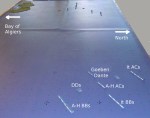
WWI Naval Battle – Bay of Algiers, 1914

This fleet action is based on the Triple Alliance naval convention of 1913, as described in “The Great War at Sea” by Sondhaus. The plan was for the Italian and Austro-Hungarian fleets and any German ships in the Mediterranean to engage the French Fleet and block the Algerian troop transports. This scenario assumes that the war starts in February 1914, and that the British Mediterranean squadron joins the French.

Due to the generally longer ranges of the Triple Alliance guns, the French and British ships were under fire and unable to respond for the first few turns. Both sides had difficulty forming coherent battle lines due to the wide variation in ship speeds and capabilities. The Goeben and Dante Alighieri eventually destroyed the three British battlecruisers. Based on the situation when we quit, the French Algerian troops could be very late arriving in France.

Scale: 1/6000 miniatures, 500 yards/in ground scale.

Rules: Computer code in development.

Visibility 24,000 yards. Wind northwesterly at 6 knots. Seastate 2.

Status at the end of the game: Alg status

Damage output file: Alg-out

Plot of ship movements: Alg-plot