Saturday the local HMGS-South group played a game of Spearhead with 3mm miniatures from Pico Armor. The scenario was based on part of the German counterattack around Kiev on December 5, 1943 – specifically the 48th Panzer Corps vs. the 1st Tank Army and the 18th Army.
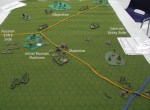
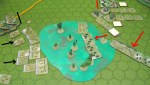
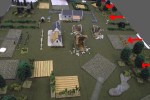
Starting setup. The hexgrid is not used for these rules.
All other forces arrive on turn 1.
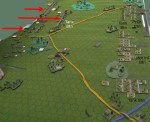
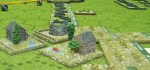
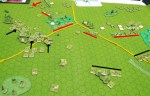
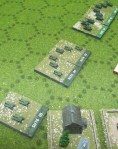
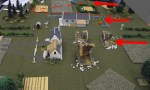
German motorized infantry dismounts and advances on the northern objective village.
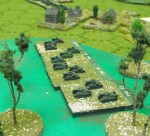
A tank battalion of Pz IVs attempts to outflank the village.
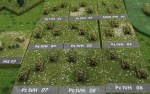
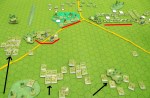
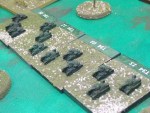
On the southern flank, Russian tanks and PzGr head into the woods.
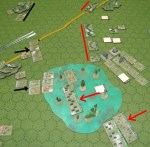
The northern village is assaulted.
Two-thirds of the village is taken.
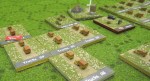
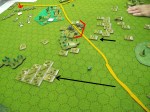
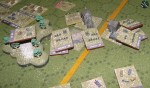
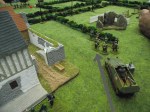
On the southern flank, the heavy tanks duel while other Russian tanks advance against the PzGr.
We played for about four hours, by which time only a portion of one objective was taken by the Germans.
Saturday the local HMGS-South group played a game of Hail, Agrippa!. The Hail, Agrippa! rules are a modification of Hail Caesar published in Issue 66 of ‘Wargames, Soldiers and Strategy’ magazine. [Hail Agrippa! rules link]
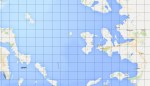
The scenario was based on the Battle of Chios, 201 BCE. Philip V of Macedon has given up his siege of Chios and is attacked by an allied fleet primarily from Rhodes and Pergamum. The primary source is Polybius.
The players were allowed a free setup, done secretly and without knowledge of the composition of the opposing fleet. There were five players. The Macedonian fleet had three divisions (one for each player) and the Rhodian fleet had four divisions (two for each player). The Macedonian fleet was larger, but of lower quality than the Rhodian fleet.
The rules were modified in three ways:
(1) The command rolls used a D10 [1to3=1 move, 4to6=2 moves, 7to9=3 moves, 10=blunder].
(2) The unit values were specific to each fleet. The Rhodians were generally faster and had better morale values.
(3) Break results did not eliminate full size units. Stands were replaced with half-size stands (two ship models) with combat and stamina values halved.
The poor quality photos are the result of my forgetting my camera and having to use a cell phone.
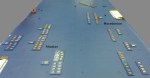
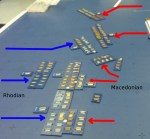
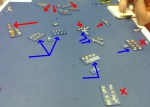
View from the east after turn one.
The Rhodians advance rapidly to attack the Macedonian left and center.
The light ships of the Macedonian left wing lose units, but occupy half of the Rhodian fleet for most of the game.
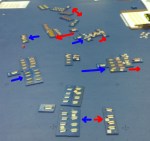
The fight in the center results in units pushed back on both sides. A series of blunder command rolls prevents the Macedonian right wing from getting into battle.
The Macedonian right wing commander rolled 5 blunders, mostly in the early turns. This effectively kept about a third of the fleet out of the battle.
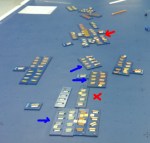
The Macedonian left is finally destroyed. The Rhodians redeploy to face the new threat from the west.
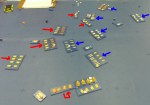
View from the south at the end. The Macedonian right wing and the Rhodian reserve are still intact.
After about 4 hours of play we had to quit. The battle was still close at the end, with about equal numbers of undamaged units.
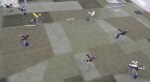
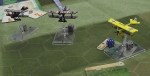
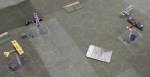
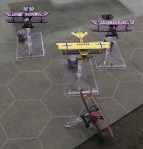
This weekend the local HMGS-South group played a Wings of War (aka Wings of Glory WWI) game. Two Bristol F.2B on a bombing mission are escorted by two Camels. The Germans intercept with two DVII and two DVa.
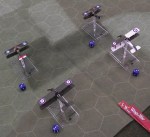
The initial setup.
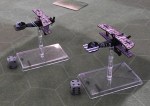
DVa. The dice are used to record altitude.
The British.
One Bristol heads straight for the target.
The target is bombed successfully.
Good formation flying by three German players.
A DVII pilot is killed by being wounded twice.
A Camel pilot sacrifices himself to cover the escape of the other British planes.
The score at the end was one fighter lost on each side and the target bombed by one Bristol. The second Bristol was unable to overfly the target due to rudder damage.
This weekend the local HMGS-South group played a Bolt Action game. The scenario was a meeting engagement between infantry forces.
Infantry squads advance on to the table. Each side hid a mortar team in the corner behind woods.
Machine gun and advancing infantry fire hits and pins a German squad in the upper left. German infantry occupies a two-story objective house.
Russian infantry occupies the other objective house (top). The Russian mortar causes heavy casualties to the infantry in the two-story objective house.
Assault combats eliminate one Russian and two German squads.
With most of the German infantry gone, we called this a Russian victory.





You must be logged in to post a comment.