Saturday the local HMGS-South group played a medieval battle at the Dogs of War shop using the Hail Caesar rules.
Gilgenburg Prussia, July 13th, 1410.
On July 13th, two days before the battle of Grunwald/Tannenberg, the Polish-Lithuanian army captured and sacked the town of Gilgenburg (Dabrowno in Poland today). In this hypothetical scenario, the Teutonic Order army arrives to defend Gilgenburg.
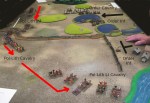
Approaching from the north (right in the photo), the Order forces are divided by the lakes. Order infantry deploys to keep Polish-Lithuanian light cavalry out of Gilgenburg.
Poor command rolls for the Order cavalry allow most of the Polish army to move east of the stream. Most of the rear Polish infantry division is driven off the table.
When the game ended both sides had lost 4 units (20%) and each side was threatened on the left flank. The Polish-Lithuanian light cavalry division had cleared the way to Gilgenburg.
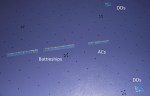
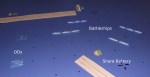
A-H DDs make smoke to cover the deployment of the fleet.
The A-H divisions turn south to get more maneuver room. The French turn north to keep the leeward position. A French AC blows up and another turns out of line with steering damage.
The French take advantage of the good visibility to fight beyond the range of half of the A-H ships.
This scenario was not balanced well due to the French advantage in gun range and the slow speed of the oldest A-H ships.
As a counterpart to a recent hypothetical battle where the German battlecruisers were sent into the channel to intercept the BEF transports, this scenario assumes the High Seas Fleet demonstrates in the North Sea to draw the Grand Fleet away from the channel. The GF intercepts the HSF as it moves south along the Danish coast toward the Jade.
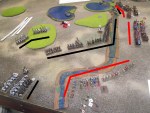
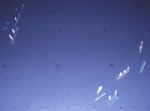
North is to the the left and the Danish coast is off the table to the rear. When sighted, the GF was across the path of the HSF. This photo is several turns later.
The British dreadnoughts have turned south to avoid German torpedoes. The German dreadnoughts have all taken damage and turned to the west to clear the Danish coast.
A British AC has blown up. British dreadnoughts continue south, chased by German torpedo boats.
The battle lines attempt to reform, but slower damaged ships start to fall behind.
At the point where we stopped, both battle fleets had taken significant damage and it was expected that a lot more ships would soon be sunk.
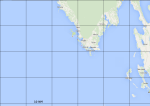
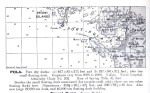
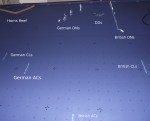
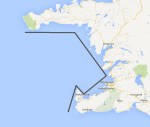
The German Asiatic and Mediterranean squadrons are attempting to return to Germany in September of 1914. Scouting Group I has evaded the British in order to escort them back. While coaling in Faxa Bay Iceland, they are caught by the Battlecruiser Fleet.
German light cruisers were required to stay stationary for the first three turns (15 minutes) and were limited to an ordered speed of 10 knots on turn 4. German heavy ships were required to stay stationary for the first four turns and were limited to an ordered speed of 5 knots on turn 5 and 10 knots on turn 6. The Goben and the three battlecruisers of the 2nd BCS were limited to 22 knots due to maintenance issues.







 ncc1717.com
You must be logged in to post a comment.