Saturday the local HMGS-South group played a Napoleonic game at the Dogs of War shop using a modified version of the Empire V rules. The game was a introduction to the rules, so no specific historical battle was represented. Each player had a division of infantry, cavalry and artillery.
15mm figures from a variety of manufacturers.
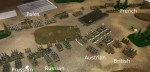
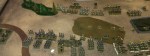
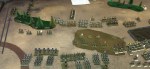
Prussians and Russians (foreground) face Poles and other French allies.
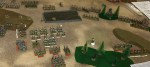
Austrians and British (foreground) face French.
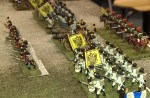
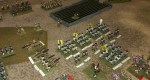
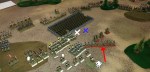
The Austrians advance in a compact mass in the center.
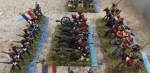
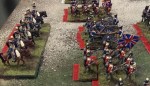
French cavalry quickly destroy the British and Austrian cavalry, then turn to face the exposed Allied infantry.
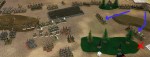
Prussian cavalry attempt a wide flanking move.
French cavalry hit an Austrian column in the flank and destroy it. They are then seen off by British infantry fire.
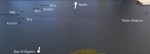
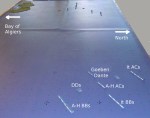
This fleet action is based on the Triple Alliance naval convention of 1913, as described in “The Great War at Sea” by Sondhaus. The plan was for the Italian and Austro-Hungarian fleets and any German ships in the Mediterranean to engage the French Fleet and block the Algerian troop transports. This scenario assumes that the war starts in February 1914, and that the British Mediterranean squadron joins the French.
Due to the generally longer ranges of the Triple Alliance guns, the French and British ships were under fire and unable to respond for the first few turns. Both sides had difficulty forming coherent battle lines due to the wide variation in ship speeds and capabilities. The Goeben and Dante Alighieri eventually destroyed the three British battlecruisers. Based on the situation when we quit, the French Algerian troops could be very late arriving in France.
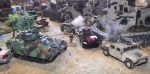
Saturday the local HMGS-South group played a modern period game using the Rapid Fire rules. The six players each had a team of US troops in a vehicle (mostly Humvees). The objective was to enter a village and capture an arms dealer selling US equipment to the opposition.
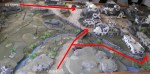
The plan…..
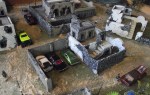
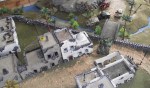
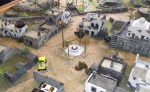
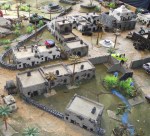
The village.
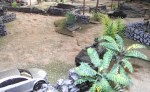
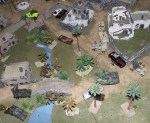
The opposition with some US equipment, including Humvees with TOWs.
An enemy TOW heavily damages the US commander’s vehicle.
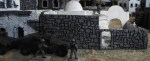
Enemies appear from several buildings as the US forces approach.
The arms dealer is captured. A civilian vehicle is commandeered to get prisoners out of town.
This fleet action is based on the low point of Grand Fleet numerical superiority over the High Seas Fleet, as described in Massie, Robert K., “Castles of Steel,” Chapter 20, page 372. Based on the results of the Dogger Bank scenario played earlier, the opposing battle cruisers are still under repair.
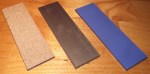
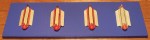
The 1/1200 scale ancient ships were temporarily re-based for Hail, Agrippa! simply by sticking the old individual bases to cardboard. In order to use the same ships for various game systems, they are being fitted with rare earth magnets. Custom 40 mm x 130 mm magnetic hardboard bases were made by Good Ground LLC. The magnetic material on the bases is intended for transport using steel drawers. Here they are being used upside down so the rare earth magnets on the ships will stick. This allows for variations in the type, number and positions of ships.
[Edit: Since the Good Ground bases are magnetic, a piece of ferrous metal on the bottom of the ship model works as well or better than a rare earth magnet. My recent ships have been built using a small zinc-plated steel washer or a square of tin-plated steel sheet. This is easier and cheaper than the magnets.]
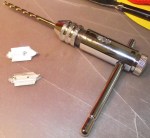
Tap wrench used as a large pin vice to drill holes for magnets.
From the left: Right side up, upside down, painted.



 ncc1717.com
You must be logged in to post a comment.