This weekend the local HMGS-South group played a Northwest Frontier game at the Dogs of War shop using The Sword and the Flame colonial rules, Revision 1.
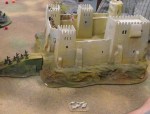
June 1882, near Black Mountain on the east side of the Indus valley. The pass below Black Mountain is blocked by a hostile tribe in a fort. The following British forces were ordered to take the fort. The fort was hand-made by Ian Weekley.
B Company, 2nd Gurkha Rifles
Detachment of the 19th Bengal Lancers Royal Artillery with Gatling gun Indian Artillery with mountain gun
The British deploy. A Pathan unit appears outside the fort. The fort was built by Ian Weekley.
Gurkha deployed in open order
Russian ‘observers’ are sent out of the fort, but are quickly shot down by the Gurkhas.
The rough ground is scouted. The Royal Artillery crew of the Gatling (on the elephants) is wiped out by the fort’s gun.
More Pathans appear to reinforce the fort.
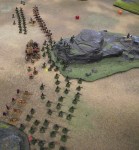
In spite of heavy casualties, Gurkhas advance toward the gate.
Gurkha firing lines trade shots and casualties with Pathans on the walls. The Bengal lancers, in near mutiny, refuse to advance.
The gate is blown open. The defending Pathan units fail their tests when charged and the fort is taken.
The Pathan leader sneaks out and pretends to be a sheepherder.
This weekend (November 23, 2013) the local HMGS-South group played a 1879 Zulu War game at the Dogs of War shop using The Sword and the Flame colonial rules, Revision 1.
Date: June 1879, second invasion of Zululand
Location: Near Fort Newdigate, guarding the supply line of the main army advancing on Ulundi.
Situation: Supply columns had been attacked by Zulu raiding parties based in hilly terrain overlooking the track to Ulundi. A force was organized from the garrison of Fort Newdigate and ordered to clear the hills of Zulu. This force consisted of three platoons of infantry, one platoon of Naval Brigade rifles, a detachment of the 17th Lancers and one Gatling gun.
The Zulu force consisted of six units (mixed rifle and spear) hidden in rough terrain. Other Zulu units would arrive when firing could be heard from the battle.
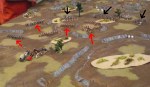
The British advance. Zulu hidden positions are in the distance.
A couple of Zulu units break cover and advance.
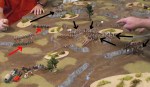
The British form firing lines while the remaining Zulu leave their hidden positions in the hills and advance.
The right end of the British line is charged from all sides.
The right end of the British line is overwhelmed.
Zulu reinforcements. Most would not be needed.
The British fall back to face threats from several directions as Zulu arrive on the field behind them.
Significant casualties on both sides in the final clashes. An odd blue box appears to mark a 50th anniversary.



















You must be logged in to post a comment.