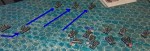
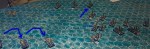
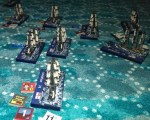
Saturday the local HMGS-South group played a Revolutionary War naval game at the Dogs of War shop using the Flying Colors rules. The scenario was a simplified version of the battle of Cape Henry, 16 March 1781. Old Glory miniatures were used instead of the games ship counters.
The British line split into two formations and attempted to double the French van, but the French maneuvered downwind to avoid this. A 120 degree wind shift then gave the French the weather gage. The British sustained more damage overall, although the leading French ship accumulated enough hull damage to strike her colors.
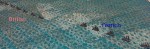
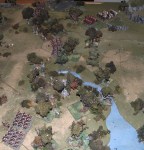
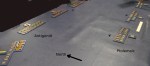
With nine ships in each fleet, only the leading ships fit on the table at the start.
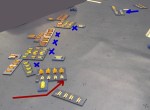
On the second turn the British split into two formations. The French maneuver in a single line for several more turns.
A stern rake forces the leading French ship to strike.
The British switch from formation commands to group commands.
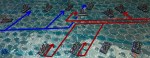
The rear of the French line comes into action at long range.
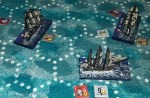
The flagship of the British second in command is nearly dis-masted. The British struggle to maneuver around the crippled French ship which has struck.
This is a very speculative attempt to model a double-hulled ship carrying a siege tower in 1/1200 scale. Demetrius I Poliorcetes or Lysimachus may have used something like this for siege operations against cities in the early 3rd Century BCE. See Chapter 6 of “The Age of Titans” by Murray.
The model uses the hulls of two 1/900 scale Ramming Speed ships by Valiant Enterprises. The tower is 30 meters tall in 1/1200 scale, or about 3/4 of the estimated height of Helepolis.
Saturday the local HMGS-South group played a Napoleonic game at the Dogs of War shop using a modified version of the Empire V rules. The game was a introduction to the rules, so no specific historical battle was represented. Each player had a division of infantry, cavalry and artillery.
15mm figures from a variety of manufacturers.
Prussians and Russians (foreground) face Poles and other French allies.
Austrians and British (foreground) face French.
The Austrians advance in a compact mass in the center.
French cavalry quickly destroy the British and Austrian cavalry, then turn to face the exposed Allied infantry.
Prussian cavalry attempt a wide flanking move.
French cavalry hit an Austrian column in the flank and destroy it. They are then seen off by British infantry fire.
This fleet action is based on the Triple Alliance naval convention of 1913, as described in “The Great War at Sea” by Sondhaus. The plan was for the Italian and Austro-Hungarian fleets and any German ships in the Mediterranean to engage the French Fleet and block the Algerian troop transports. This scenario assumes that the war starts in February 1914, and that the British Mediterranean squadron joins the French.
Due to the generally longer ranges of the Triple Alliance guns, the French and British ships were under fire and unable to respond for the first few turns. Both sides had difficulty forming coherent battle lines due to the wide variation in ship speeds and capabilities. The Goeben and Dante Alighieri eventually destroyed the three British battlecruisers. Based on the situation when we quit, the French Algerian troops could be very late arriving in France.
Saturday the local HMGS-South group played a modern period game using the Rapid Fire rules. The six players each had a team of US troops in a vehicle (mostly Humvees). The objective was to enter a village and capture an arms dealer selling US equipment to the opposition.
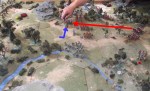
The plan…..
The village.
The opposition with some US equipment, including Humvees with TOWs.
An enemy TOW heavily damages the US commander’s vehicle.
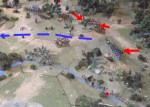
Enemies appear from several buildings as the US forces approach.
The arms dealer is captured. A civilian vehicle is commandeered to get prisoners out of town.
You must be logged in to post a comment.