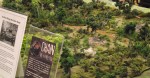
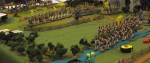
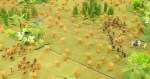
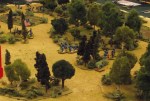
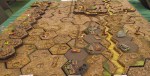
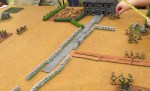
This weekend the local HMGS-South group played a Bolt Action game.
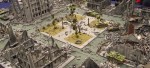
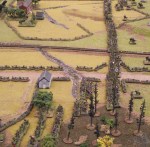
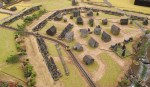
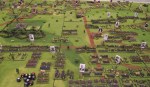
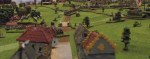
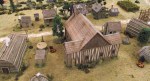
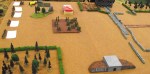
The U.S. 116th Regimental Combat Team (RCT) is pushing west along the coast after breaking out of the Omaha beachhead. The 116th RCT commander has ordered B Company to take the German coastal artillery position outside the village of Maisy. The German artillery is shelling Allied shipping off of Utah beach and has thus far proven impossible for Allied aircraft and naval guns to destroy.
The German positions are defended by elements of the 914th Grenadier Regiment and the remains of several Ost companies.
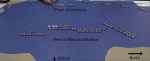
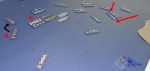
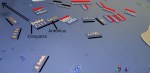
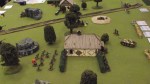
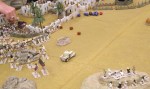
US forces enter at the bottom with the objective of clearing the crossroads area of enemy troops. The minefield must also be cleared.
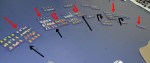
A lucky hit takes out the MG in the bunker, but it is replaced by a full squad of German infantry.
The recon vehicle is destroyed.
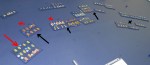
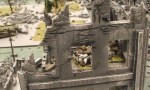
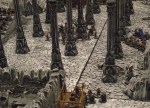
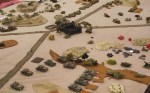
Mortar fire convinces German troops to shift positions in the ruins. US infantry advance on both flanks.
US infantry take loses on both flanks but keep advancing. The TD advances to within point blank range of the bunker. The Ost squad is eliminated, having fought far better than expected.
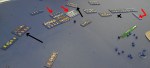
US infantry occupies some of the ruins on the right. The German squad leaves the bunker to destroy the TD by close assault.
At the end of the game (eight or nine turns) the crossroads was mostly clear of German troops, but a German half-track remained and the minefield had not been cleared.
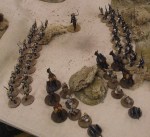
Saturday the local HMGS-South group played a game of Hail, Agrippa!. The Hail, Agrippa! rules are a modification of Hail Caesar published in Issue 66 of ‘Wargames, Soldiers and Strategy’ magazine. [Hail Agrippa! rules link]
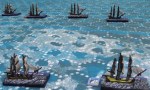
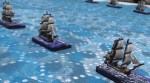
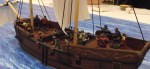
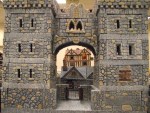
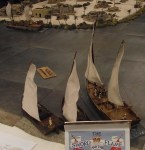
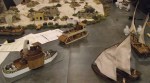
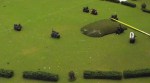
The scenario was a hypothetical battle set during the siege of Rhodes by Demetrius son of Antigonus. Ptolemy has sent a fleet to lift the siege. It is met by the Antigonid fleet in the narrows between Evlimnia (Alimia) island and the mainland of Rhodes.
View from the island of Rhodes toward Makry (Makri) island with Evlimnia (Alimia) and Chalki in the distance.
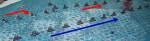
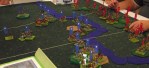
Good command rolls allow the Antigonid divisions to race forward to support their isolated ships near Evlimnia.
One Antigonid division continues to advance while another balks. Blunders in the Ptolemaic center delay the advance.
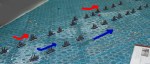
Casualties accumulate for both sides in the center. The Ptolemaic division near Makry blunders several times and never gets into action.
The flank attack by the Antigonid heavy ships from Evlimnia finally goes in, but does little damage initially.
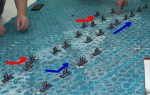
The flank attack becomes effective, but losses are still about even.
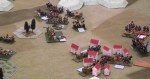
We quit at this point due to the time. With the battle a draw, the siege of Rhodes can continue.
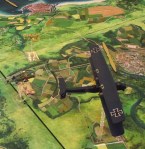
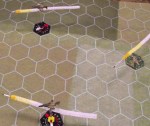
This weekend the local HMGS-South group played a WWI naval battle. In this hypothetical engagement, the Germans send a portion of the High Seas Fleet into the Gulf of Finland in an attempt to engage and destroy the Russian Baltic Fleet. The date is March 15, 1915. The scenario is similar to a previous test.
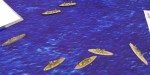
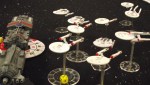
German CLs form up and attack the threatening Russian DDs to the north.
German DNs maneuver to avoid Russian torpedo attacks. The Russian boats are heavily damaged by German CLs.
German DNs and CLs evade torpedo attacks.
We quit at this point due to time. The damage was relatively even. The Russian destroyers and torpedo boats and the German light cruisers did most of the fighting. One dreadnought had been sunk on each side.
You must be logged in to post a comment.