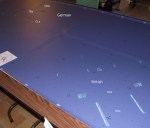
The view looking SE. Light cruiser screens have just spotted each other at 20,000 yards.
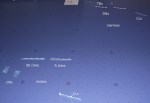
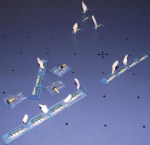
View looking N. The British have deployed to the south and then turned east. The Germans have sailed north and then west.
The dreadnought divisions spiral closer. British light forces are staying out of range of the deadly 15cm guns on the German dreadnoughts.
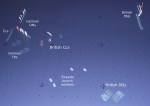
The British light cruisers stage a suicidal attack to cover the torpedo attack of the destroyers. The destroyers have turned away after they launched.
The game was ended at this point due to time. A few additional turns were played on the computer. The German dreadnoughts avoided the torpedo attack, although two light cruisers were hit.
This weekend the local HMGS-South group played a Rapid Fire scenario based on Soviet efforts to retake the Baltic States in the Fall of 1944.
Before deploying the Russian forces, the players plan their attack. The main objective is the fortified artillery position at the end of the table. Cutting the road to the right is a secondary objective.
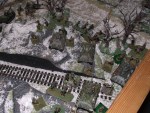
The Russians advance across the rail line.
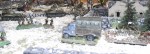
An AT gun hides next to a building.
The main objective in the far distance.
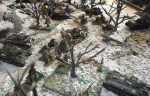
Russian troops attack through the woods.
The gully provides temporary cover in the advance.
The first defense line (StuGs and infantry) is taken.
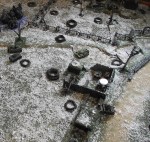
A lone Sherman reaches the main defense position.
The main objective is never threatened by the Russian attack.
The Russian attacks got near the secondary objective, but German reinforcements were positioned to stop them when we ended the game. A difficult but fun scenario, with lots of tactical choices for the players.
In this hypothetical engagement, the Germans send a portion of the High Seas Fleet into the Gulf of Finland in an attempt to engage and destroy the Russian Baltic Fleet.
The Germans have limited knowledge of the Russian dispositions. Only cruisers and torpedo boats are spotted so far.
Russian torpedo boats attempt to close to torpedo range, which for their torpedoes is only about 4,000 yards.
German light cruisers screen the battle line and shoot up the Russian torpedo boats.
The few surviving Russian torpedo boats launch, but the German dreadnoughts turn away and are not hit.
Russian destroyers attack and the German dreadnoughts turn away again. These destroyers have a slightly better torpedo with a range of about 6,500 yards.
German armored cruisers also turn away from the torpedo threat, but don’t comb the tracks quite long enough. Two ACs are torpedoed, one of which sinks. This error was caused by the week-long delay between the first half of the game (when the torpedoes were launched) and the second half (when they arrived).
Both sides try to reform their lines in the confined waters of the gulf.
The Russians Turn back to the NE. If they continued to skirt the southern shore of the gulf, the southerly wind would inhibit their shooting. Pre-dreadnoughts and armored cruisers comb torpedo tracks.
The German dreadnoughts start to take damage.
The Russian fleet has suffered much worse.
With one pre-dreadnought sunk and several large ships heavily damaged, the Russians give up the game.
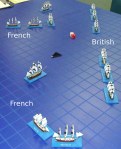
Saturday the local HMGS-South group played a Napoleonic naval game at the Dogs of War shop using Ship of the Line rules and 1/1200 scale miniatures.
A French squadron of one 120, one 80 and five 74s with average crews met a British squadron of six 74s with two elite and four crack crews.
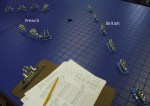
The fleets converge on a broad reach. The wind is from the left in this photo.
Long range fire damages the French 120 leading the near line on the left. This reduces her movement to the extent that she will not get into the battle.
The French maneuver while the British keep to line ahead, shooting as they pass each target.
Two French 74s break the British line. The windward French 74s (right) put on full sail to catch up.
A French 80 strikes and her 74 consort is pounded in the upper right. A British 74 in the center takes heavy damage from two 74s. The windward French 74s get into the fight.
Copenhagen the verb that is. In May 1914 the British finally accept Admiral Fisher’s suggestions (made in 1904 and 1908) to preemptively attack the German fleet in the naval base at Wilhelmshaven. A routine flight by the German Navy’s only dirigible, the L 3, spots the British in the North Sea in time for the German fleet to sortie.
Visibility was 14,000 yards. Wind was westerly at 8 knots and the seastate was 2.
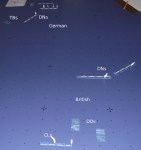
The light cruiser screens have formed up in line ahead. The fist hit has blown up HMS Southampton.
British fleet. The wreck of the Southampton is visible in the upper right corner.
German fleet
The light cruisers withdraw under fire from battleships.
Two British dreadnoughts in the lead division have been lost to turret hits followed by magazine explosions.
The fleets close to around 5000 yards as damage mounts. British destroyers have launched torpedoes and withdrawn.
German torpedoes hit the British line, crippling or sinking several ships. With the British clearly worsted, the Riskflotte theory is vindicated.
Analysis:
Examining only the battleship action, the British hit rate was 9.3% and the German hit rate was 14.1%. This difference was the result of the westerly wind blowing the gun and funnel smoke in front of the British line, while the German smoke was blown to the disengaged side. The British needed the guidance in the Grand Fleet Battle Orders (~ May 1916):
Weather …The leeward position, with the wind on the engaged bow, is usually the better … the main consideration is that of being in a position where the gun and funnel smoke from our own ships do not interfere with gunlaying… [page 15]
I don’t know if there was any such guidance in May of 1914.
The British suffered gun losses due to 29 turret face penetrations. Four British battleships were lost to explosions as a result of turret fires reaching the magazines. Turret hits represented 14.7% of all hits on British ships and 12.7% of all hits on German ships. These numbers are consistent with the algorithms. The consequences (for the British) of turret hits are so significant that the algorithms for turret face hits and penetrations will be elaborated in future code modifications. For example, the probability of a turret hit for flat trajectory shells will be examined, and the curvature of British turret faces might need to be modeled.
The strategic lesson is that a preemptive attack should have been considered at an earlier date, ideally before the Germans developed effective AP shells.















 ncc1717.com
You must be logged in to post a comment.