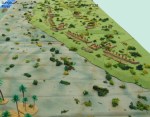
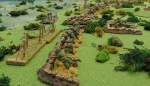
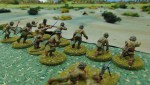
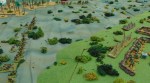
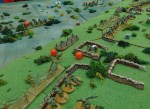
Bolt Action – Edson’s Ridge

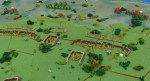
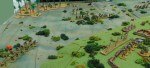
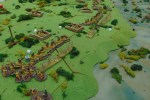
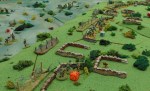
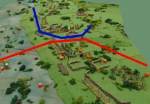
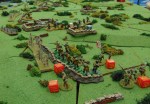
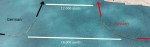
This weekend the local HMGS-South group played a Bolt Action game.  The scenario was based on the second night of the Battle of Edson’s Ridge, which occurred on the night of 13-14 September 1942. The ridge was part of the defenses of Henderson Field, Guadalcanal. This game involved the position of the 1st Marine Raider Battalion, attacked by Kokusho’s and Tamura’s battalions of the Japanese 124th Infantry Regiment.


HeroClix Klingon Battlecruisers

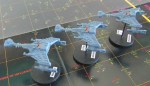
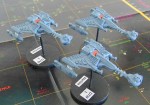
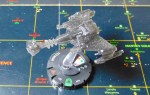
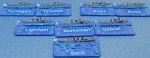
These are Star Trek HeroClix I.K.S. Amar models (from the Tactics IV set), after painting and rebasing. Compared to the normal HeroClix Klingon battlecruisers, they have extra bits sticking out from the front of the wings and from the neck, as well as other differences in detail. In most Star Trek lore the Amar is the quintessential K’t’inga class. The card that came with these models mentions the Kelvin Timeline, so that may explain the differences.

The third photo shows the unpainted Amar on the original HeroClix base.

Course Calculation for Constant Range – 1913

In October 1913, Chatfield (Beatty’s flag captain) wrote a memorandum entitled “Fast Division Work from a Gunnery Standpoint” (The Beatty Papers Vol I, Item 49, page 90). This memorandum included the following statements about changes in gunnery range:

“… the attempt to obtain a tactical, or rather a gunnery advantage, usually results in a high and frequently changing rate due to constant change of course. This must affect the gun fire, possibly … to such an extent as to entirely neutralize the value of the position gained.”

“… it is quite easy, with superior speed, to calculate suitable courses which will keep the range constant and the rate nil …”

“The T must never be crossed at too broad an angle as this is unnecessary and causes a big and difficult rate.”

Two examples are given in the memorandum for a fast division speed 5 knots greater than the enemy. Both are apparently wrong and were corrected in notes added by Beatty. Also, specifying only the difference in speed is insufficient. The solution for 10 knots and 15 knots (for example) would be significantly different from the solution for 20 knots and 25 knots.

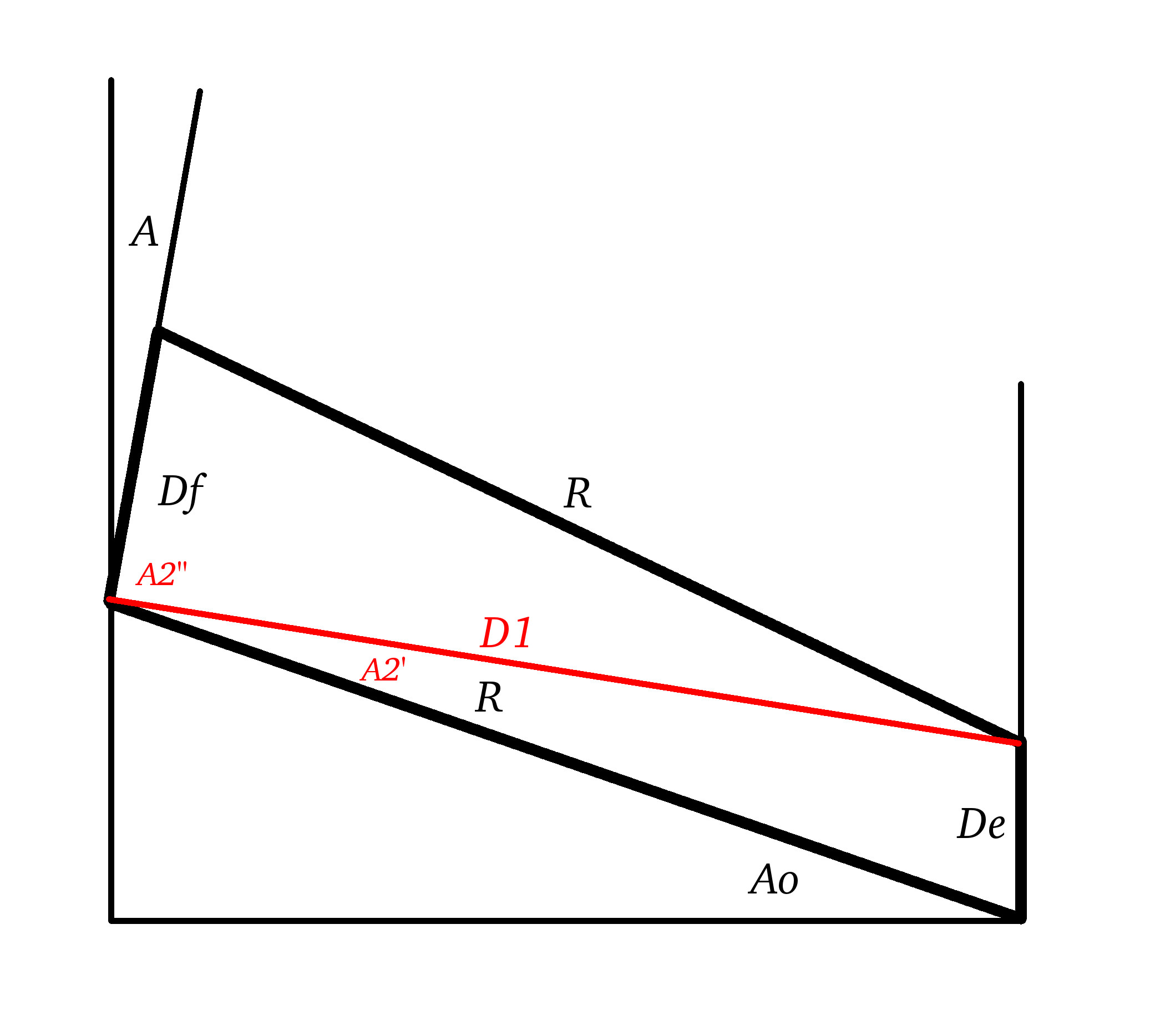
The following diagram shows the problem in a general form, where:

Ao Angle before the beam of the enemy
De Distance traveled by the enemy unit over the time interval
Df  Distance traveled by your unit over the time interval
R   Range to the enemy unit
A   Angle to steer toward enemy
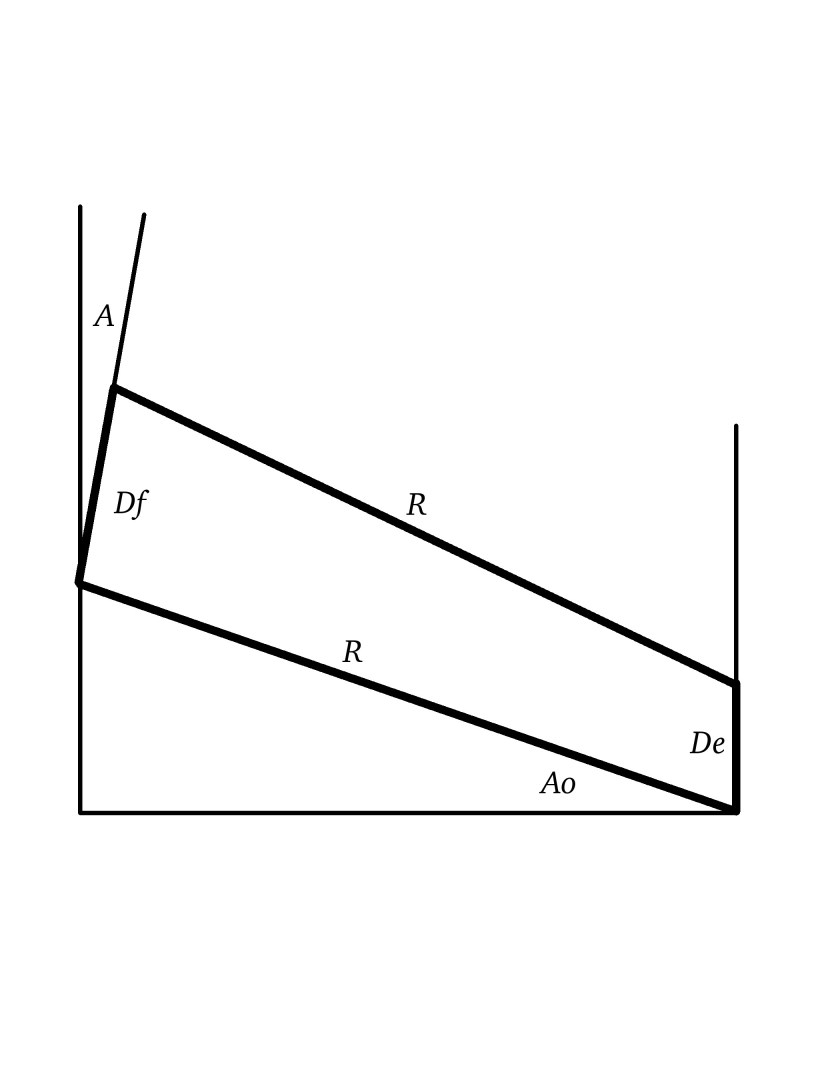
Although Chatfield says he can calculate ‘perfect gunnery courses’, the range is not precisely constant over the time interval. It is only the same at the start and end points. Line Df would need to be a curve (implying a continuous change of course) to keep the range constant at all times.

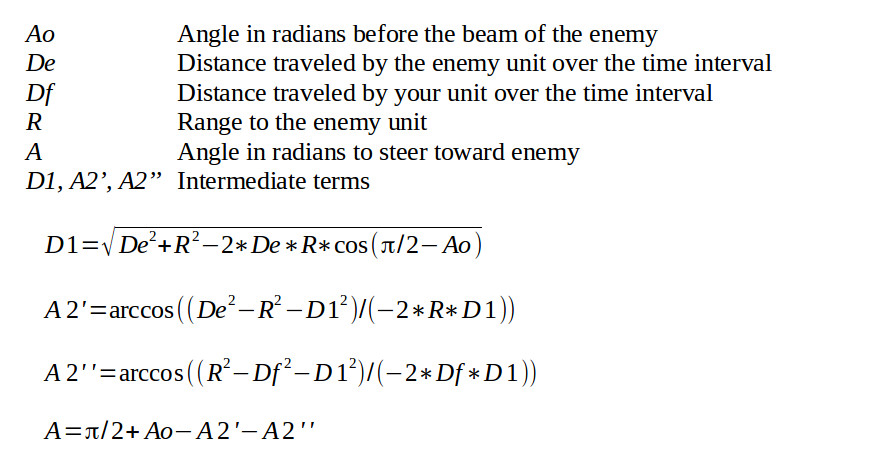
A general solution to the problem can be developed by using the Law of Cosines. The area swept by the fire range is divided into two triangles:
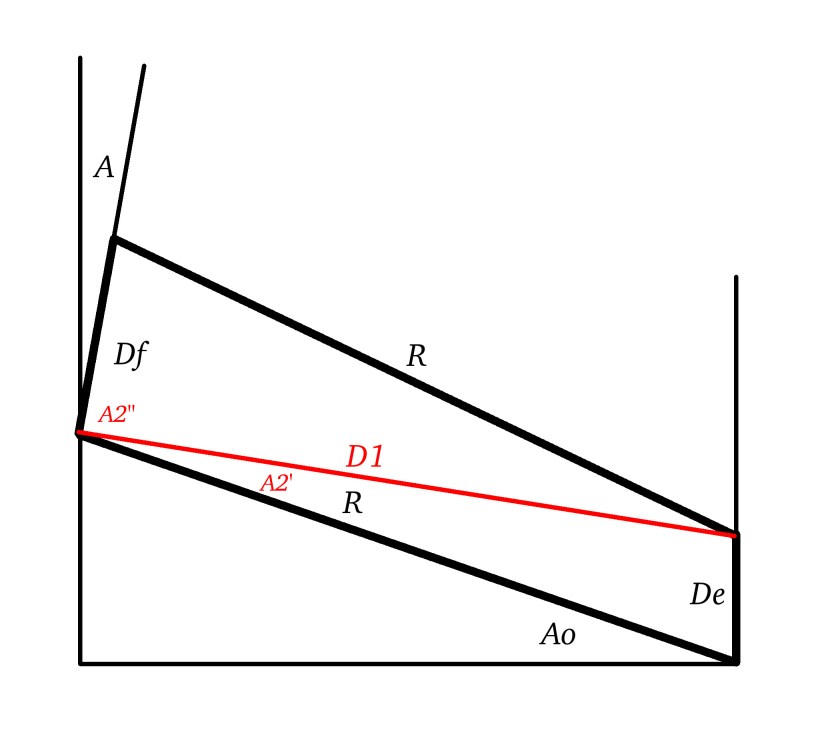
To keep the formulas to a manageable size, intermediate terms are calculated:

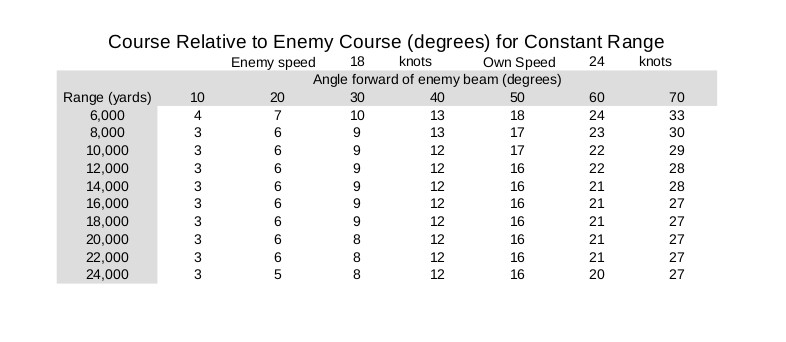
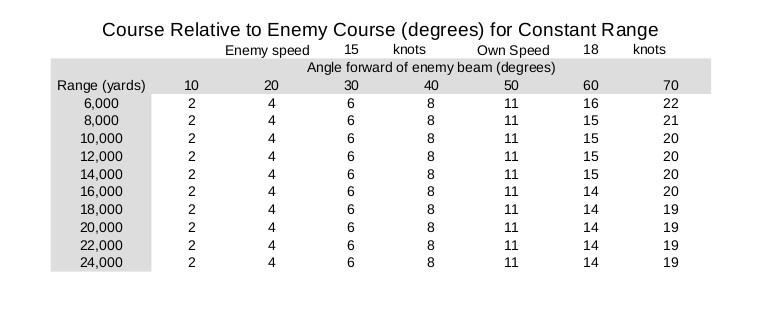
Tables for various combinations of speeds, ranges and angles can be created:
Seekrieg 5 – Gulf of Finland 1916

This weekend the local HMGS-South group played a WWI naval game using the Seekrieg 5 rules.

May 15 1916,  07:30 Western Gulf of Finland
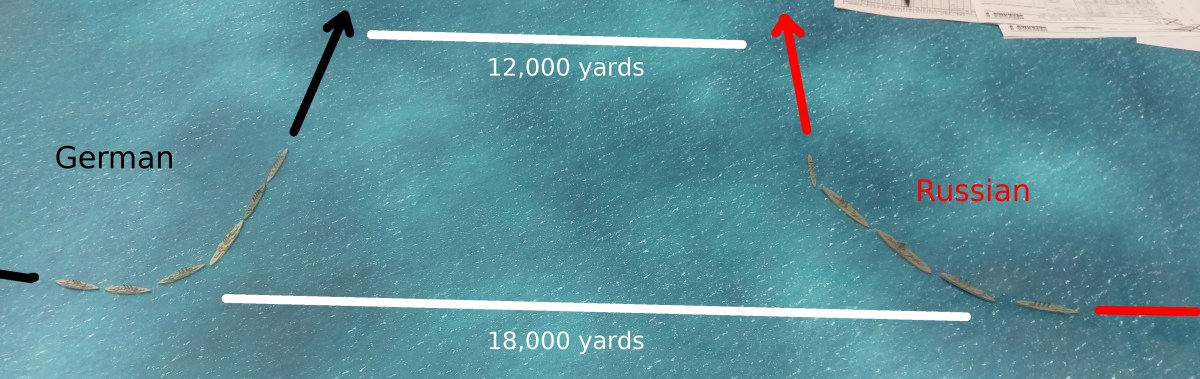
The Russians launch a heavy raid against the German patrols/ blockade of St Petersburg. The Russians sail from St Petersburg just before dusk on the 14th. At dawn both sides are sighted. Clear good weather. Visability starts ar 18,000 yards, increases to 24,000 yards by turn 5 as the morning haze lifts.

Russian:
BB Petropavlovsk
BB Gangut
CA Bayan (II)
CA Rurik
CL Jemtchug
Speed 14 knots. Course 270.

Germans:
BB Helgoland
PBB Deutschland
PBB Schlesien
PBB Hannover
CL Berlin
CA Roon
Speed 8 knots. Course 090. Initial direction to the Russians determined randomly.

Victory is based mostly on damage inflected. The Russians need to avoid a lot of damage. They cannot replace their ships, and badly damaged ships will find no safe harbor for repair. The Russians would like to “run” the Blockade to get into the German merchant shipping, but have to be only lightly damaged for that.

Mines: The Gulf of Finland has been mined by the Russians, but the Germans have prevented the Russians from maintaining the minefields. Some mines have broken loose and wandered. The mines have a low chance of contact (<5% / column of ships / turn). Slower ships can better avoid them. Only the lead ship of a column is at risk. The Russians have out of date maps, giving them some knowledge of where the mines are. Mines should influence tactics but not dominate the game. If ships stay in column there is about a 48% chance of one mine explosion in an 8 turn game.


Both sides led with light cruiser to take any mine hits. None occurred. Both sides turned to the north to bring their batteries to bear. With the rear ships out of range, the early turns pitted the two Russian dreadnoughts against the dreadnought Helgoland, while the armored cruiser Roon targeted the light cruiser Jemtchug. After 8 turns the Helgoland was a wreck (8 tiers of damage, two fires and only one remaining damage control team). No other ships had been significantly damaged. We called the game as a Russian victory.


1/6000 Naval – Various Late WW1 or Never

Filling in some of the gaps in the 1/6000 naval fleets.

[EDIT] Added some Austro-Hungarian protected cruisers and Russian seaplane carriers.